
Quick Summary:
Tube magnets are permanent magnets enclosed in non-magnetic stainless steel housings, used to attract and hold ferrous debris from product streams. They come in ceramic, neodymium (rare earth), and alnico types, each offering different magnetic strength and temperature ratings.
Selection depends on factors like magnetic strength (gauss), size, temperature, and end plug design. Regular cleaning is essential—a fully loaded magnet loses effectiveness.
Are stray metal shavings ending up in your product? If you process powders, granules, or liquids, ferrous contamination from equipment wear is a real risk. Even a single screw or chip can wreck a crusher or mixer, while fine iron dust may slip through unnoticed and ruin a batch. The good news? There’s a simple, proven fix: tube magnets.
In this guide, as a professional custom tube magnets manufacturer, I’ll cover what tube magnets are, how they work, the main types (ceramic, neodymium, alnico), their temperature limits, and key selection steps—so you can remove contamination and protect your line.

What Is a Tube Magnet?
A tube magnet is also called a magnetic tube, magnetic rod, magnetic cartridge, or finishing magnet. The design is straightforward:
- A high-strength magnetic core made of ceramic, neodymium, or Alnico
- Sealed inside a non-magnetic stainless steel tube
- Usually made from 304 or 316 grade stainless steel
- Ends that are fully welded for durability
Why non-magnetic stainless steel? Because the magnetic field needs to pass through the tube and reach the product. If the housing were magnetic, it would block the field. That would defeat the whole purpose.
The result is a powerful magnetic surface that attracts and holds ferrous debris like iron chips, screws, nails, and fine iron dust.
In my experience, people are surprised by how simple these devices are. But simple doesn’t mean weak. In fact, some high-intensity tube magnets can reach surface gauss levels of 12,000 or more. That’s serious pulling power.
How Do Tube Magnets Work?
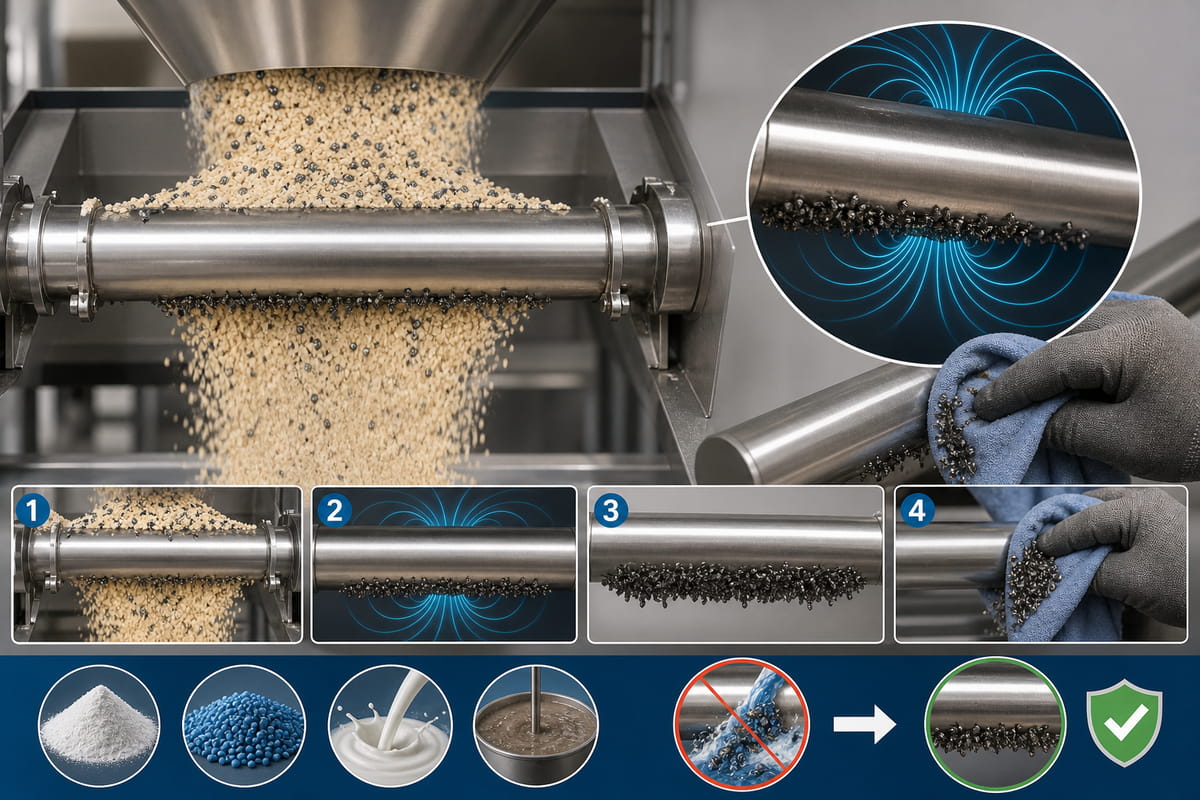
The concept is actually pretty easy to understand.
You place the tube magnet in the path of a product stream. That stream might be powder, granules, liquid, or slurry. As the material flows around the tube, the magnetic field grabs any ferrous contamination.
Here’s a step-by-step breakdown of how it works:
- The product flows over or around the tube.
- The magnetic field attracts ferrous particles to the tube surface.
- The captured metal stays on the tube. It doesn’t fall back into the product.
- Workers manually clean the tube by wiping off the captured debris.
The key is that the captured tramp metal moves to the underside of the tube. That reduces the risk of “wash-off,” which happens when product flow knocks contamination loose.
This is especially important in gravity-fed systems. When product flows fast, a weaker magnet might lose the metal it just captured. High-quality tube magnets prevent that.
That’s why I always tell people: don’t just look at the gauss rating. Look at how well the tube holds onto metal once it’s captured.
3 Common Types of Tube Magnets
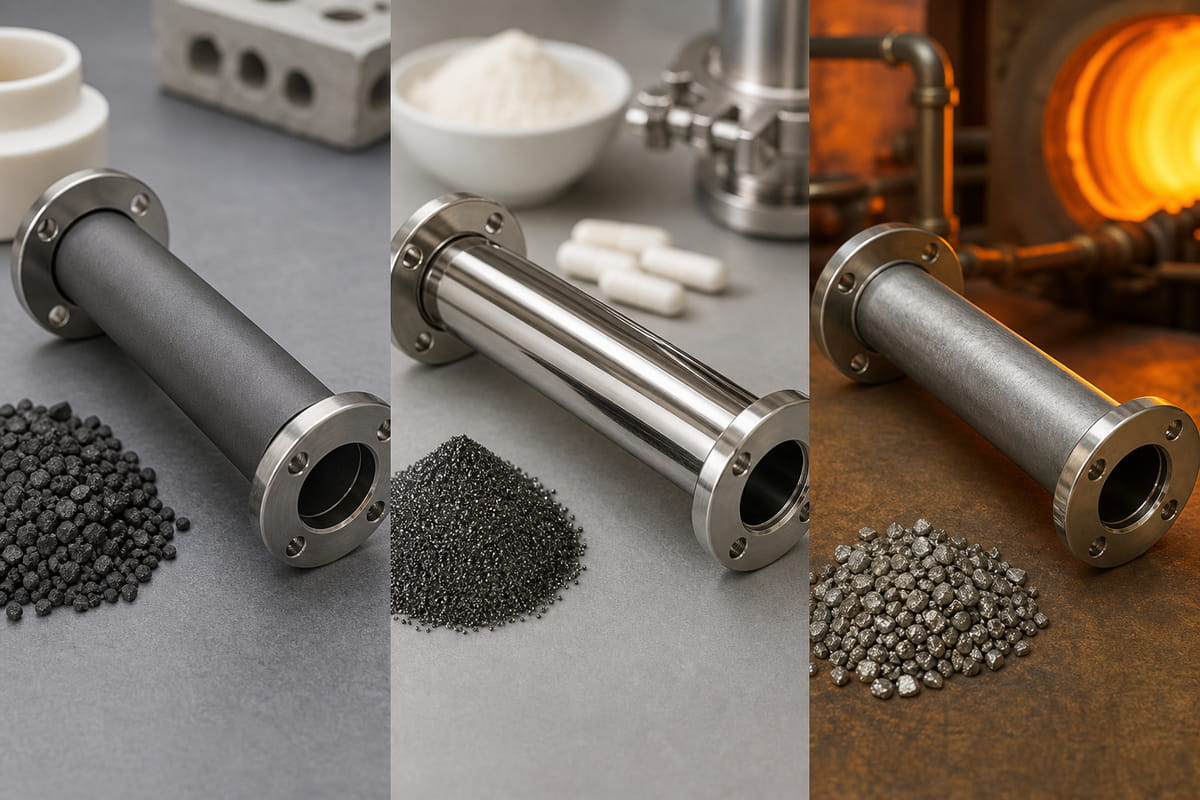
Not all tube magnets are created equal. The magnetic core determines strength, temperature resistance, and cost.
Here are the three main types you’ll run into:
Ceramic Tube Magnets
Ceramic magnets are sometimes called ferrite magnets. They’re the budget-friendly option. They provide reliable protection for basic applications and can handle higher temperatures than standard neodymium.
- Maximum temperature: around 460°F
- Good magnetic strength
- Lower cost
- Common in less demanding separation jobs
Neodymium Tube Magnets
Neodymium is where the real power is. These are rare earth magnets. They’re the strongest type you can buy. High-grade neodymium tube magnets can filter out ferrous particles as small as 30 microns.
That’s tiny.
- Extremely high magnetic strength
- Can reach 12,000 gauss or more
- Great for food and pharmaceutical applications
- Standard max temperature is around 176°F
- High-temp versions can go up to 350°C
In my opinion, if you need the highest level of product purity, go with neodymium. It’s worth the extra cost.
Alnico Tube Magnets
Alnico magnets are made from aluminum, nickel, and cobalt. They don’t have the raw strength of neodymium, but they shine in high-temperature environments.
- Maximum temperature up to 960°F
- Good stability
- Best for hot process streams
- Moderate magnetic strength
If you’re dealing with extreme heat, alnico might be the only option that works.
Where Are Tube Magnets Used for?
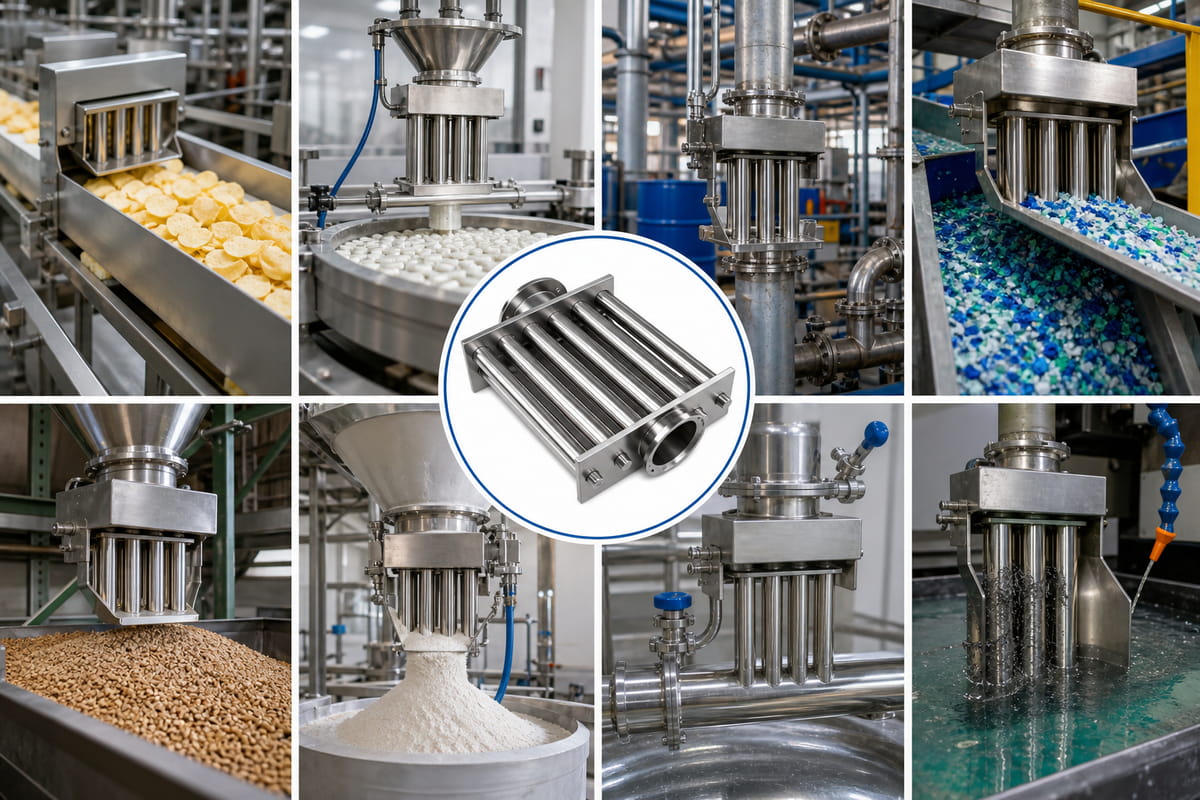
Tube magnets are everywhere. You just don’t see them because they’re usually hidden inside machinery.
Here are some of the most common applications:
- Food processing lines
- Pharmaceutical manufacturing
- Chemical production
- Plastics and recycling
- Feed and seed handling
- Powder and bulk solids processing
- Liquid filtration systems
- Coolant tanks
In food plants, tube magnets are often installed at the end of the line. They act as a final defense before packaging. That way, if any metal has made it through earlier steps, it gets caught before it ends up in a box or bag.
I’ve seen tube magnets remove everything from fine iron dust to stray nuts and bolts. They protect equipment too. A single piece of tramp metal can wreck a crusher, mixer, or extruder. Tube magnets stop that before it happens.
They can also be placed over conveyors, inside chutes, or in hoppers. Some are designed to sit directly in pipelines. Others are built into magnetic grates.
Tube Magnet Configurations: Single, Grate, and Traps
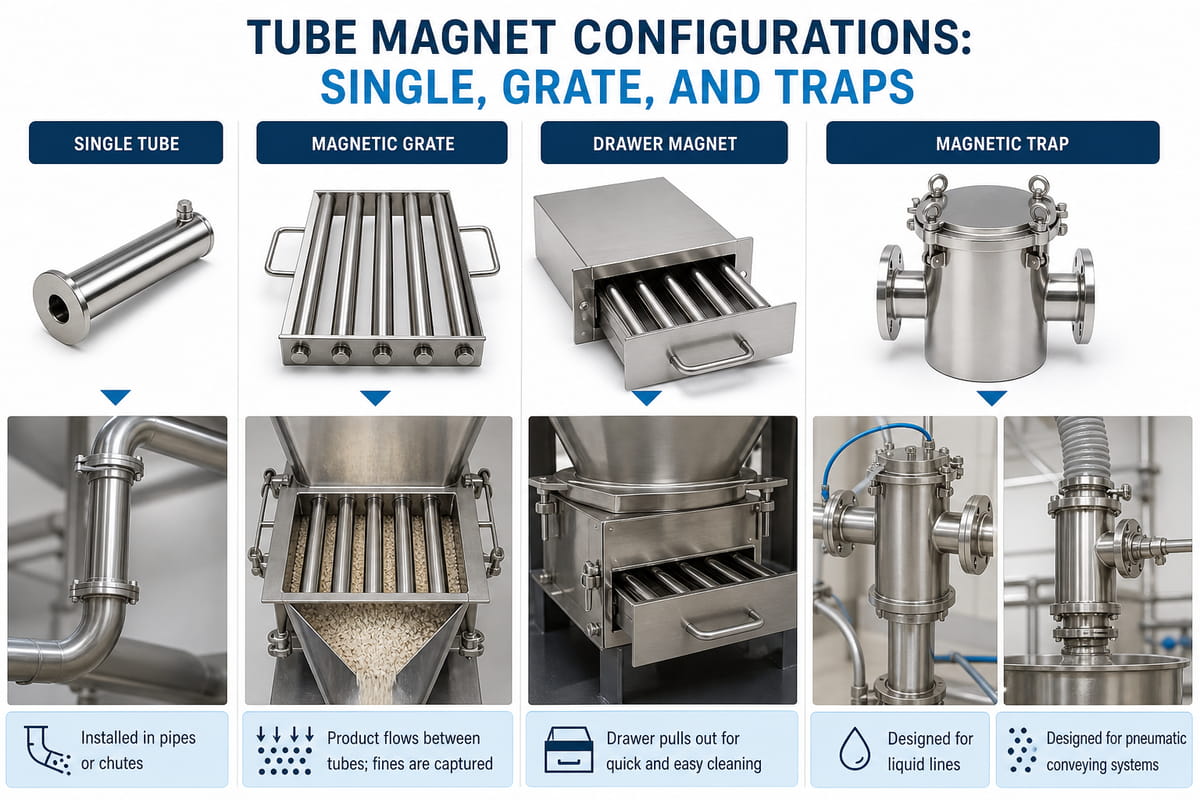
One tube magnet can do a lot. But sometimes you need more coverage.
You can use tube magnets individually, or combine them into systems:
- Single tubes: Great for simple installations in pipes or chutes
- Magnetic grates: A frame holds several tubes so product flows between them
- Drawer magnets: Tubes mounted in a drawer-style housing for easy cleaning
- Magnetic traps: Designed for liquid lines or pneumatic conveying systems
Spacing matters more than you think. If the tubes are too far apart, contamination can slip through. A good rule of thumb: the center-to-center distance between tubes should not exceed 2 inches. In many grate arrangements, the gap between tube surfaces should be around 1 inch.
Even the strongest magnet won’t help if product can flow past it untouched. Overlap your magnetic coverage.
Cleaning Tube Magnets: Don’t Let Them Get Full
Here’s something most people overlook.
A tube magnet is only as effective as it is clean.
When a magnet is fully loaded with metal, it loses efficiency. The captured debris can even block the magnetic field from reaching new contamination. That’s why regular cleaning is so important.
For most manual tube magnets, cleaning is simple: wipe the surface with a damp cloth. But high-intensity neodymium tubes can be tricky. The metal is held so tightly that it’s hard to remove.
That’s why I recommend using a thin plastic sleeve. You slide the sleeve over the tube, let debris collect on the plastic, then remove the magnet. The metal drops right off.
Pro Tip: Set a cleaning schedule based on how much metal is in your product. Fine powders load tubes faster than pellets or larger materials. Check early and often.
Some manufacturers offer self-cleaning systems too. These are ideal for high-volume operations where manual cleaning is too slow.
How to Choose the Right Tube Magnet
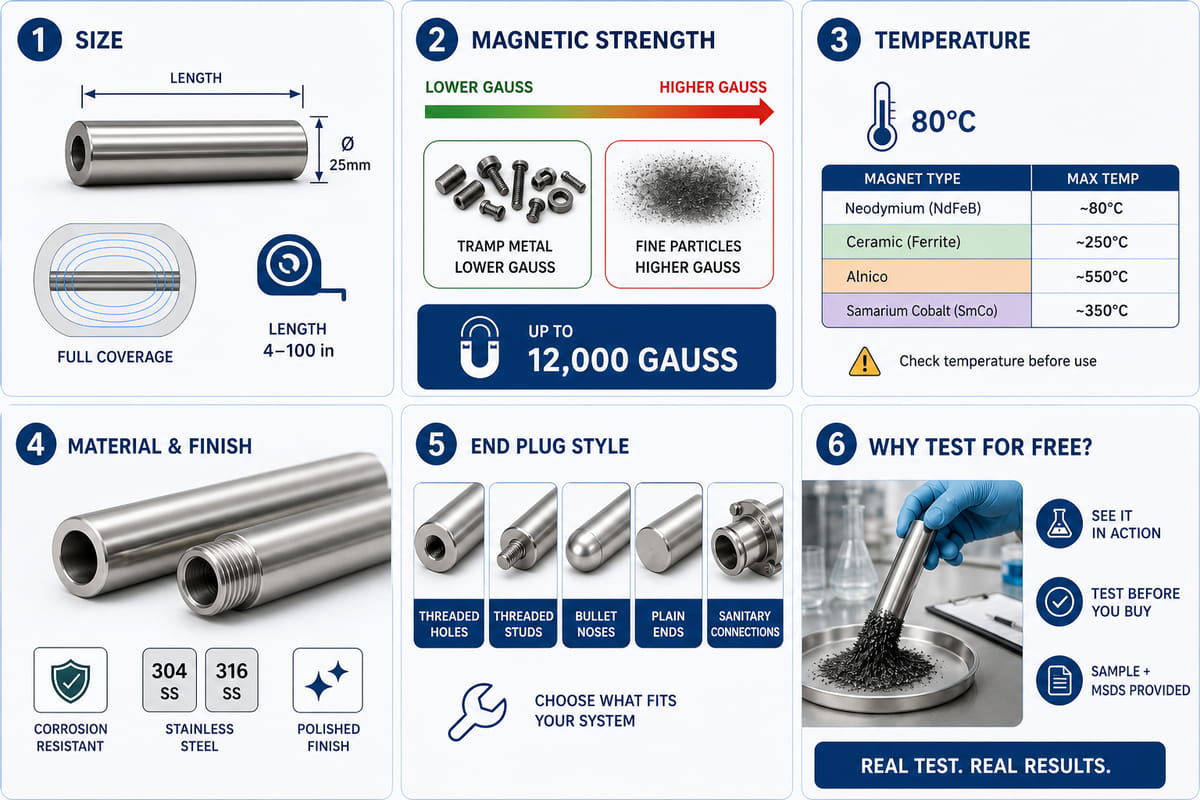
Choosing the right tube magnet doesn’t have to be complicated. But you do need to match the magnet to your application.
Here are the factors I always consider:
1. Diameter and Length
The standard diameter is 1 inch, or 25mm. That works for most applications. But custom sizes are available. Lengths can range from 4 inches all the way up to 100 inches or more.
For existing pipelines, the magnetic core should match the diameter of the pipe. That ensures full coverage.
2. Magnetic Strength
Think about the size of contamination you need to catch.
Larger tramp metal can be caught with lower gauss. Fine iron particles require higher strength. For critical industries like batteries and pharmaceuticals, you want around 12,000 gauss. That’s the level where tiny particles become easy to catch.
3. Temperature
Standard neodymium tube magnets are rated for about 80°C. If your process runs hotter, you’ll need high-temperature magnets.
Ceramic handles more heat. Alnico handles the most. And for extreme conditions, samarium cobalt is also available.
Always check the temperature rating before you buy. A magnet that loses its strength in your process is useless.
4. Material and Finish
For food and pharmaceutical use, choose 304 or 316 stainless steel. Both are corrosion-resistant and easy to clean. A polished finish also meets hygienic standards.
If corrosion is a concern, consider a special coating like a synergistic finish.
5. End Plug Style
Tube magnets come with different end designs:
- Threaded holes
- Threaded studs
- Bullet noses
- Plain ends
- Sanitary connections
Pick the one that makes installation easiest in your system.
6. Dead Space
Some tube magnets have “dead space” at the ends. That means the end section isn’t magnetic. This makes cleaning easier, but it also means no protection in that area. Make sure dead space is outside the product flow.
Many reputable manufacturers offer free product testing. Send them a sample of your product with an MSDS sheet. They’ll tell you whether a tube magnet can handle it. Take advantage of that.
Hollow Tube Magnets: Another Meaning
Here’s a quick twist.
Sometimes the term “tube magnet” refers to something completely different.
In engineering and prototyping, a tube magnet can be a hollow, cylindrical magnet. These aren’t used for separation. Instead, they’re used in:
- Sensors
- Fluid handling systems
- Linear motion assemblies
- Motors and actuators
These hollow tube magnets provide precise axial or diametric magnetic fields. They’re valuable for low-volume production and specialized applications.
So before you order, make sure you know which type you’re dealing with. The name might be the same, but the application is totally different.
Safety First: Handling Strong Magnets

Let me be clear about something.
High-intensity tube magnets are extremely powerful. They can cause serious injuries if handled carelessly.
Here are a few safety rules I always follow:
- Keep tube magnets in their packaging until you’re ready to use them
- Wear thick protective gloves
- Keep them away from other metal objects
- Be careful when two strong magnets get close to each other
- Warn everyone who handles them
The biggest risk is pinching. If your finger gets between a magnet and a steel surface, it can hurt. A lot.
Treat powerful magnets like the tools they are. Respect them.
The Bottom Line
Tube magnets are simple, powerful, and incredibly useful. They protect products, equipment, and reputations. Whether you’re removing metal from cookie dough or cleaning coolant, there’s a tube magnet built for the job.
As we move into 2026, magnetic separation technology keeps getting better. Stronger magnets. Better coatings. Smarter designs. But the core idea hasn’t changed: a magnet inside a steel tube can make your product cleaner and safer.
If you’re dealing with ferrous contamination, don’t overthink it. Start with the right tube magnet, place it correctly, clean it on schedule, and you’ll see the difference.
So the next time someone asks, “What are tube magnets?” you’ll know exactly what to say.


