
Quick Summary:
Cone magnets are permanent neodymium magnets shaped like a tapered cone. The wide base captures magnetic flux, and the narrow tip concentrates it, creating a strong, targeted pull. That makes them ideal for glass whiteboards, precision alignment, sensors, and industrial flow applications.
Choose by matching tip size to your contact surface, checking pull force, grade, and coating. Handle them carefully: neodymium cone magnets are brittle, dangerous around pacemakers, and can pinch or shatter if snapped together.
Have you ever tried to pin a thick stack of paper to a glass whiteboard with a regular flat magnet—and watched it slide straight down? That frustration is common. The glass creates an air gap, and standard disc magnets lose most of their grip. But here’s the thing: the shape of the magnet can fix it.
In this guide, as a professional custom cone magnets manufacturer, I will share what are cone magnets, why the tapered tip concentrates magnetic force, and how that focused pull solves problems like glass boards, prototyping, and easy removal. We’ll also cover types, pull forces, safety, and how to choose the right one.
What Are Cone Magnets, Exactly?
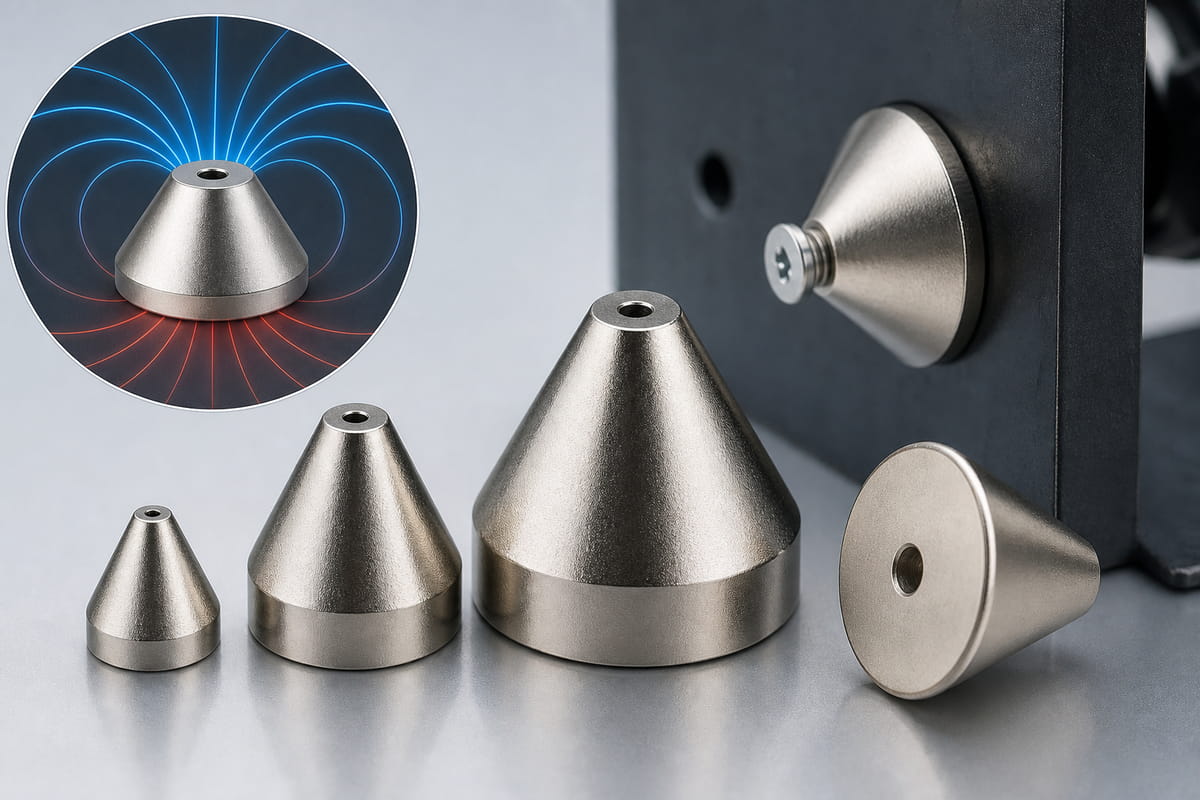
Cone magnets are rare-earth neodymium magnets shaped like a tapered cone. They have a broad base and a pointed tip. Usually, they’re magnetized axially—with the north pole on the tip and the south pole on the base (or vice versa). That may sound simple, but it’s the geometry that makes them special.
When magnetic field lines are forced through a smaller surface area, they become denser. Think of water flowing through a garden hose. If you pinch the end, the water sprays out with more force. Same idea with a cone magnet. The wide base collects the field, and the narrow tip concentrates it into a focused, high-strength point.
The result? You get an extremely strong, targeted pulling force at the tip, while the wide base gives you a natural handle to grab and pull off.
Pro Tip: This is why cone magnets are often described as “pin wall magnets” or “glass board magnets.” The small tip holds the note, but the big base lets you tilt the magnet off the surface without fighting the full force.
Why the Cone Shape Changes Everything
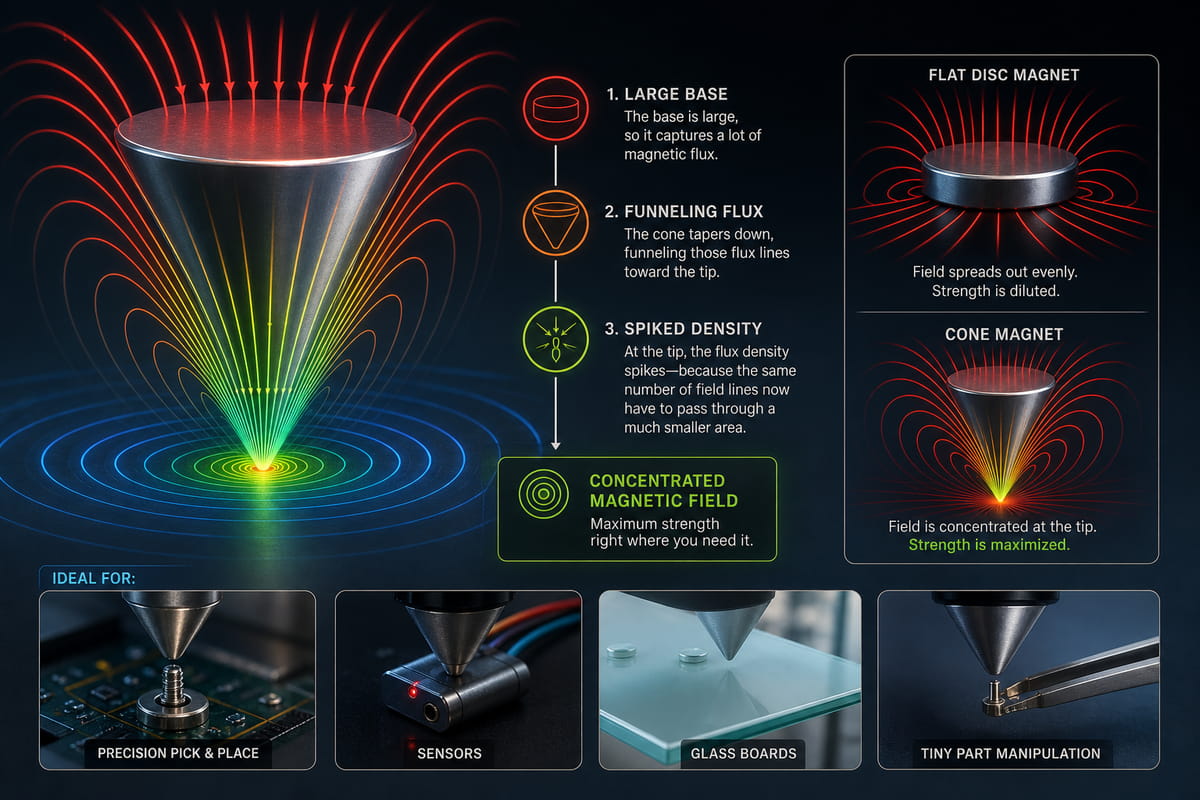
Most magnets you’ve used are flat discs or blocks. The magnetic field spreads out evenly across the face. That’s fine for general holding, but if you need strength in a specific spot, you’re wasting a lot of energy.
A cone magnet flips that around.
Here’s what happens:
- The base is large, so it captures a lot of magnetic flux.
- The cone tapers down, funneling those flux lines toward the tip.
- At the tip, the flux density spikes—because the same number of field lines now have to pass through a much smaller area.
This creates what engineers call a concentrated magnetic field. And that’s exactly what you want for precision work, sensors, and glass boards.
Let me give you a real example. On a 10mm thick glass whiteboard, a standard flat magnet might slide right off. The glass creates an air gap, and the magnetic field weakens quickly with distance. But a cone magnet with a small tip presses the field right through the glass, reaching the steel backing behind it. The tip essentially acts like a focus lens.
That’s why you’ll see neodymium cone magnets recommended for glass whiteboards and magnetic glass boards. They don’t just hold better—they also release easier because you can rock them off.
The Science Behind the Concentration
I’m going to keep this simple, because the physics can get complicated fast.
Neodymium magnets are made from an alloy of neodymium, iron, and boron (NdFeB). They’re the strongest type of permanent magnet commercially available. Size for size, nothing else comes close. And when you shape that neodymium into a cone, something interesting happens.
The magnetic field lines that normally spread out from a flat face get funneled down the taper. By the time they reach the small tip, the field density is much higher. That’s why a cone magnet can have a pull force at the tip that’s several times higher per square millimeter than a flat disc magnet of the same diameter.
But here’s the thing: the total magnetic energy doesn’t increase. It’s just moved around. The base may actually have less holding power per square millimeter than the tip. So the cone shape is not about making the magnet stronger overall—it’s about moving the strength to where you need it.
That concentrated magnetic field is what makes cone magnets ideal for applications where you need directional force, precision alignment, or the ability to penetrate an air gap like thick glass.
Common Characteristics of Cone Magnets
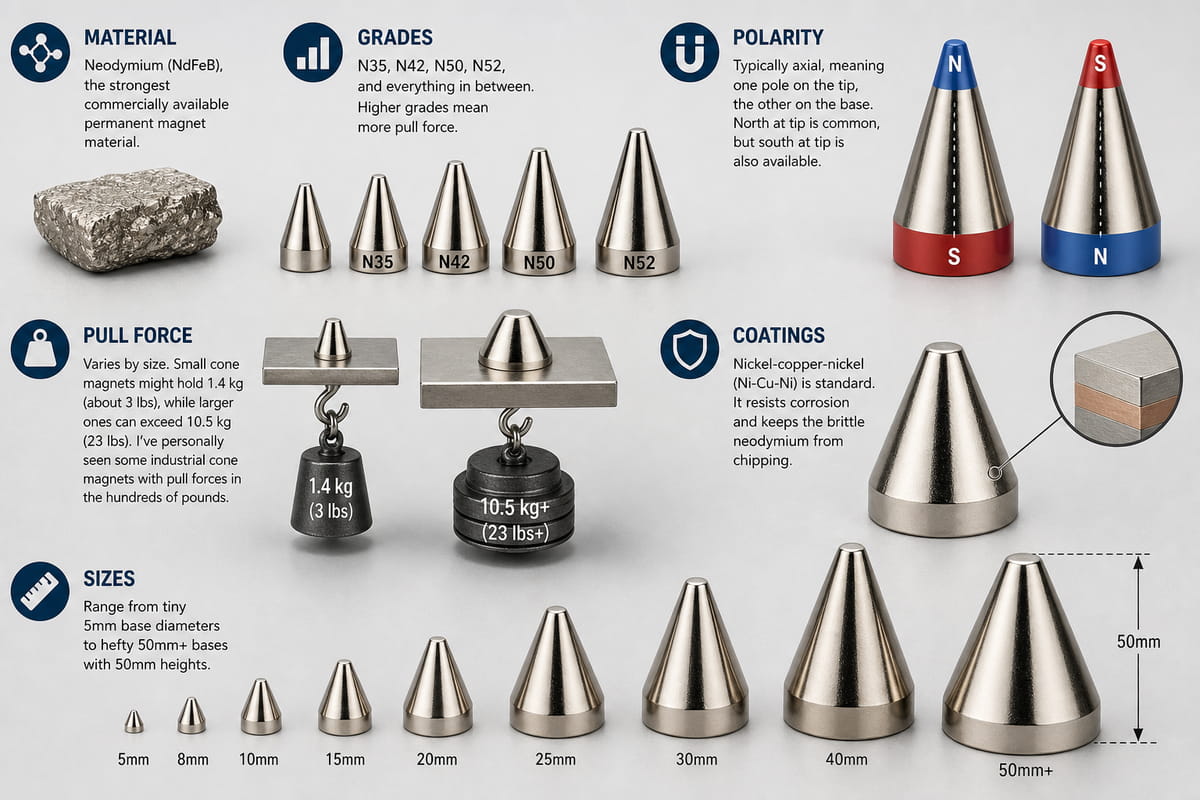
If you’re shopping for cone magnets, here are the specs you’ll see most often:
- Material: Neodymium (NdFeB), the strongest commercially available permanent magnet material.
- Grades: N35, N42, N50, N52, and everything in between. Higher grades mean more pull force.
- Polarity: Typically axial, meaning one pole on the tip, the other on the base. North at tip is common, but south at tip is also available.
- Pull force: Varies by size. Small cone magnets might hold 1.4 kg (about 3 lbs), while larger ones can exceed 10.5 kg (23 lbs). I’ve personally seen some industrial cone magnets with pull forces in the hundreds of pounds.
- Coatings: Nickel-copper-nickel (Ni-Cu-Ni) is standard. It resists corrosion and keeps the brittle neodymium from chipping.
- Sizes: Range from tiny 5mm base diameters to hefty 50mm+ bases with 50mm heights.
Here’s the thing: because they’re made from neodymium, they’re brittle. If you let two cone magnets snap together, they can crack or shatter. That’s why manufacturers always say: handle with care.
What Can You Use Cone Magnets For?
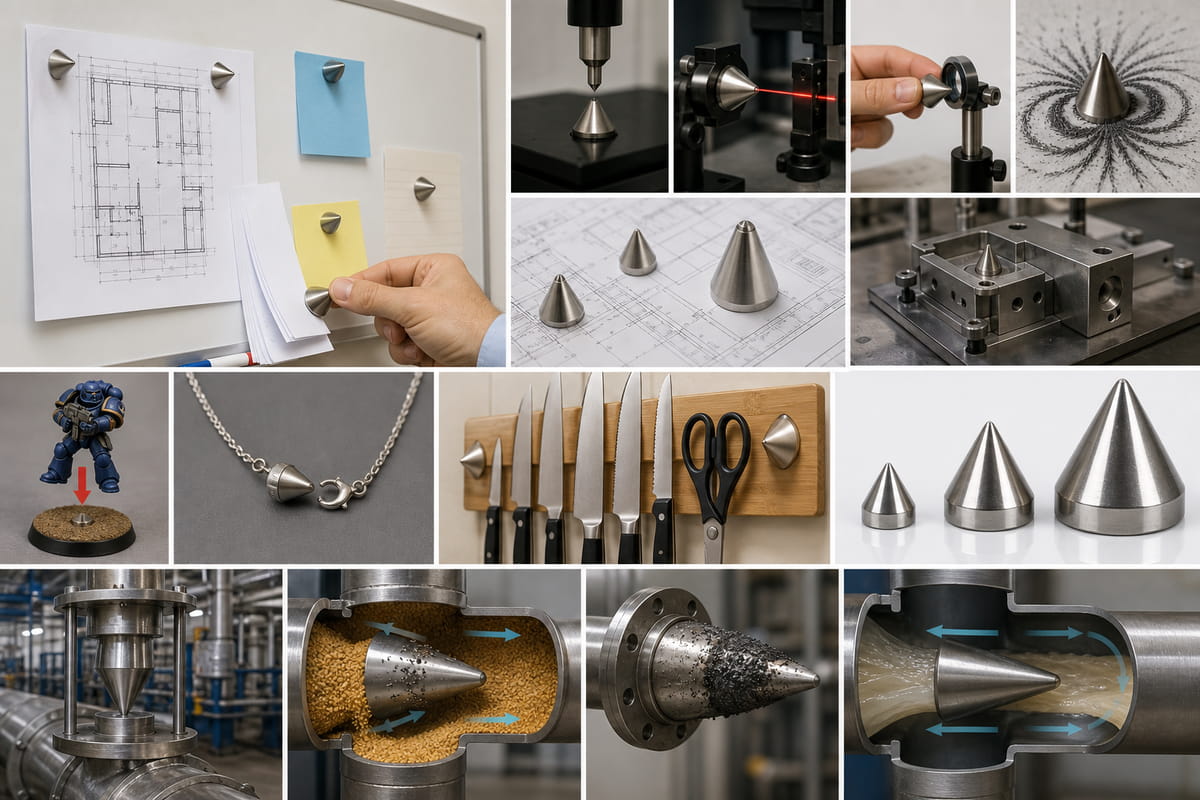
Now for the fun part. What are cone magnets used for? Let me count the ways.
Office & Whiteboards
This is the most common use case. Standard whiteboards and especially glass boards are thick. Regular magnets lose grip fast. Cone magnets solve that.
The small tip delivers a tight hold on the board, while the wide base sticks out, giving you something to grab. You can tilt the magnet off the board by pressing on the base edge. That’s huge when you’re holding a thick stack of papers, blueprints, or heavy cardstock.
I’ve personally tested this setup. On a 6mm glass whiteboard, a 20mm cone magnet held 15+ sheets of paper without sliding. A flat disc magnet of the same diameter slipped with 5 sheets.
Why? The cone’s tip concentrates the flux, penetrating the glass and reaching the steel backing. The flat magnet wasted too much field in the air gap.
Science, Engineering & R&D
If you’re into prototyping, sensors, robotics, or research, cone magnets are a secret weapon.
Because the tip creates a pinpoint magnetic vector, you can use them for:
- Sensor calibration
- Precision alignment
- Optical system adjustments
- Magnetic field demonstrations in labs
- Prototyping magnetic fixtures
For example, in robotics, you might need a magnet that only attracts from one small point. A cone magnet gives you that focused pull without interfering with nearby components.
And in medical research, the concentrated field at the tip is useful for experiments that require a localized magnetic field. Nothing beats the cone when you need maximum performance from a small pole face.
Hobby & Craft
This is where cone magnets really shine for everyday makers.
- Model making: Warhammer and miniature gaming. Cone magnets let you secure miniature figures to bases with a small, hidden magnet point. The base of the cone sits inside the model, and the tip holds the figure.
- Jewelry: The cone shape adds a nice design element, and the strong tip can hold clasps or closures.
- Knife racks and tool holders: Attach the wide base to a wall or board, and the pointed tip holds knives, scissors, or tools. When you pull the tool off, the small contact area releases easily, while the base stays firmly attached. It’s a brilliant design.
Industrial Flow Magnets (Bullet/Center-Flow)
Wait, cone magnets in industrial settings? Yes. But these are much bigger and often called bullet magnets or center-flow magnets.
They’re installed inside pipelines or chutes to remove ferrous contaminants from free-flowing powders, grains, or liquids. The cone shape sits in the center of the flow stream, catching metal particles as they pass. The wide base is the mounting point, and the tapered cone directs product flow around the magnet.
I won’t get too deep into industrial food safety, but the same principle applies: concentrated magnetic field, maximized removal efficiency.
How to Choose the Right Cone Magnet
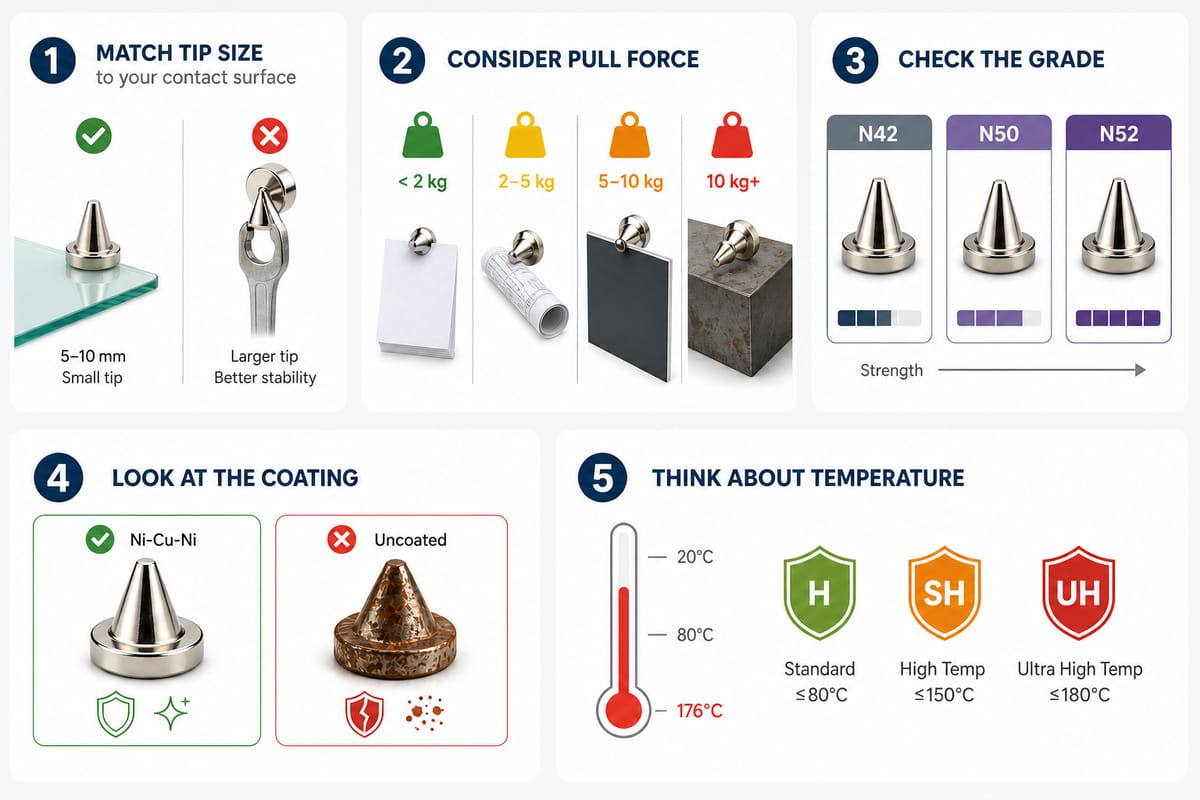
So you’re sold. Here’s how to pick the right one.
Step 1: Match the tip size to your contact surface.
The tip’s surface area determines how well it grips. If you’re mounting on a glass board, a small tip (say 5–10mm diameter) works best because it focuses the field through the glass. For holding a tool, a slightly larger tip may be better for stability.
Step 2: Consider the pull force you need.
Manufacturers list pull force in kilograms or pounds. As a rule of thumb:
- Under 2 kg: Holding a few sheets of paper.
- 2–5 kg: Thick stacks, blueprints, or light tools.
- 5–10 kg: Heavy cardstock, signs, or small tools.
- 10 kg+: Industrial or high-stress holding.
Pro Tip: The rated pull force is measured on a flat, clean, thick steel plate with direct contact. Any air gap (like glass) reduces that number significantly. That’s why the cone’s concentrated tip helps—it minimizes the effective air gap.
Step 3: Check the grade.
N42 is the most common grade for general use. It balances strength and cost. N50 or N52 gives you maximum power, but the magnet becomes more brittle and sensitive to heat. For most office or hobby applications, N42 is plenty.
Step 4: Look at the coating.
A good nickel-copper-nickel (Ni-Cu-Ni) coating is standard. It prevents corrosion and makes the magnet smoother. Avoid uncoated neodymium if you’re in a humid environment—it will rust.
Step 5: Think about temperature.
Neodymium magnets lose strength as temperature rises. Standard grades work up to 80°C (176°F). If you need higher heat resistance, look for H, SH, or UH grades. For normal room-temperature use, you don’t need to worry.
Safety Tips for Handling Neodymium Cone Magnets

I can’t skip this part. These things are dangerous if you’re careless.
Here’s the deal:
- Keep them away from pacemakers. Strong magnetic fields can disrupt medical devices.
- Not for children. Small magnets are a choking hazard. If swallowed, they can pinch intestines and cause serious injury—or death.
- Brittle. Neodymium magnets are hard but brittle. If they slam together, they can shatter, sending sharp fragments flying. Always slide them apart, never pull directly.
- Watch your fingers. Pinch injuries are real. When two strong magnets snap together, they can pinch skin hard enough to draw blood.
- Avoid electronics. Keep magnets away from credit cards, hard drives, and other magnetically sensitive items.
Pro Tip: To separate two stuck cone magnets, slide one off the stack sideways. Don’t try to pull them straight apart. Use the edge of a table as leverage. And wear gloves if you’re handling very large ones.
Cone Magnets vs. Flat Disc Magnets: Which Should You Choose?
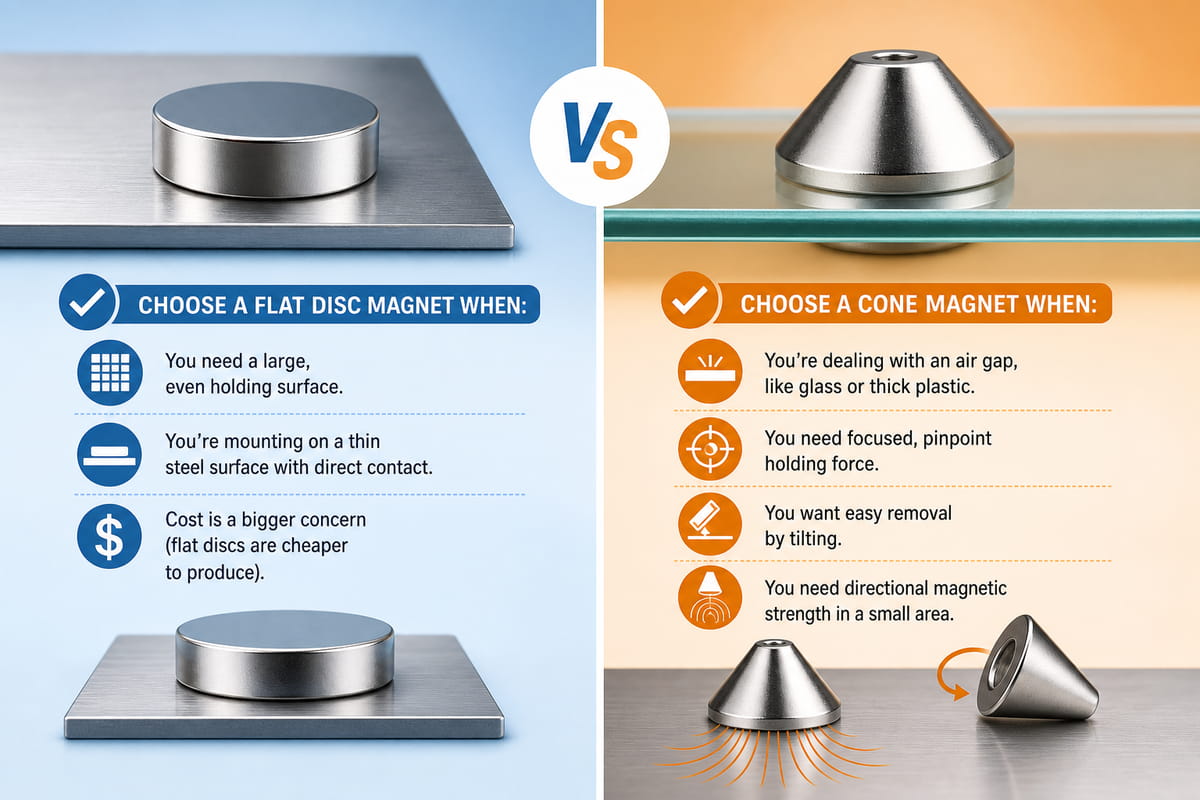
This is a question I get a lot. And the answer depends on what you’re doing.
Choose a flat disc magnet when:
- You need a large, even holding surface.
- You’re mounting on a thin steel surface with direct contact.
- Cost is a bigger concern (flat discs are cheaper to produce).
Choose a cone magnet when:
- You’re dealing with an air gap, like glass or thick plastic.
- You need focused, pinpoint holding force.
- You want easy removal by tilting.
- You need directional magnetic strength in a small area.
In my experience, cone magnets are the clear winner for glass boards and any application where you need to pull the magnet off frequently. The wide base acts as a built-in handle. That alone saves you frustration—and fingernails.
Frequently Asked Questions About Cone Magnets
Do cone magnets provide directional strength?
Yes. Their tapered design concentrates magnetic force on the smaller surface. The tip delivers strong axial pull, while the base remains relatively weaker per square millimeter. That makes them ideal for targeted applications.
Can you use cone magnets on glass boards?
Absolutely. In fact, glass boards are one of the best use cases for cone magnets. The concentrated field at the tip penetrates the glass to reach the steel backing, giving a surprisingly strong hold. And the cone shape lets you tilt the magnet off easily, unlike flat magnets that stick flush and are hard to pry.
Are cone magnets safe around electronics?
No. Neodymium cone magnets produce strong magnetic fields that can damage credit cards, pacemakers, hearing aids, and hard drives. Keep them away from anything magnetically sensitive.
What’s the difference between a cone magnet and a bullet magnet?
They’re essentially the same shape—tapered with a wide base and narrow tip. The term “bullet magnet” is often used for larger industrial versions installed in pipelines for metal contaminant removal. “Cone magnet” is the more general term for the shape, including small office and hobby versions.
Conclusion
So, what are cone magnets? They’re not just a novelty shape. They’re a smart engineering solution that concentrates magnetic force exactly where you want it—at the tip. They solve real problems like holding on glass, releasing without a fight, and delivering pinpoint magnetic fields for research and prototyping.
Now you know what are cone magnets, how they work, and where to use them. The next step is to grab a few, test them on your own whiteboard or project, and see the difference for yourself.


