
Quick Summary:
Segment magnets are curved, tile-like permanent magnets that form circular or cylindrical assemblies. They are commonly used in motors, generators, magnetic couplings, sensors, bearings, wind turbines, and medical or scientific equipment because they create focused magnetic fields and are easier to manufacture than large, complex ring magnets.
NdFeB is the default for most high-performance applications, while SmCo suits high-temperature or corrosion-sensitive environments, and ferrite offers a lower-cost option. Choosing the right segment magnet requires checking magnetization direction, operating temperature, mechanical stress, demagnetization risk, manufacturing tolerances, coating, and bonding.
Designing a motor, generator, or magnetic coupling often hits a wall when you need a strong, directional magnetic field in a circular geometry. A single one-piece ring magnet seems ideal, but sintered rare-earth magnets are brittle, hard to press, machine, and magnetize in large complex shapes—and those rings are expensive or impossible to make. Get the angle, radius, or thickness wrong, and you can ruin a motor’s cogging torque profile. The good news? You can avoid all of these by choosing segment magnets.
In this guide, as a professional custom segment magnets manufacturer, I will share what segment magnets are, how materials like neodymium, SmCo, ferrite, and alnico compare, which magnetization direction fits radial vs. axial flux systems, and how to specify size, angle, and coating. You’ll also see why segment magnets dominate EV motors, generators, and magnetic couplings—and which common mistakes to avoid before you order.
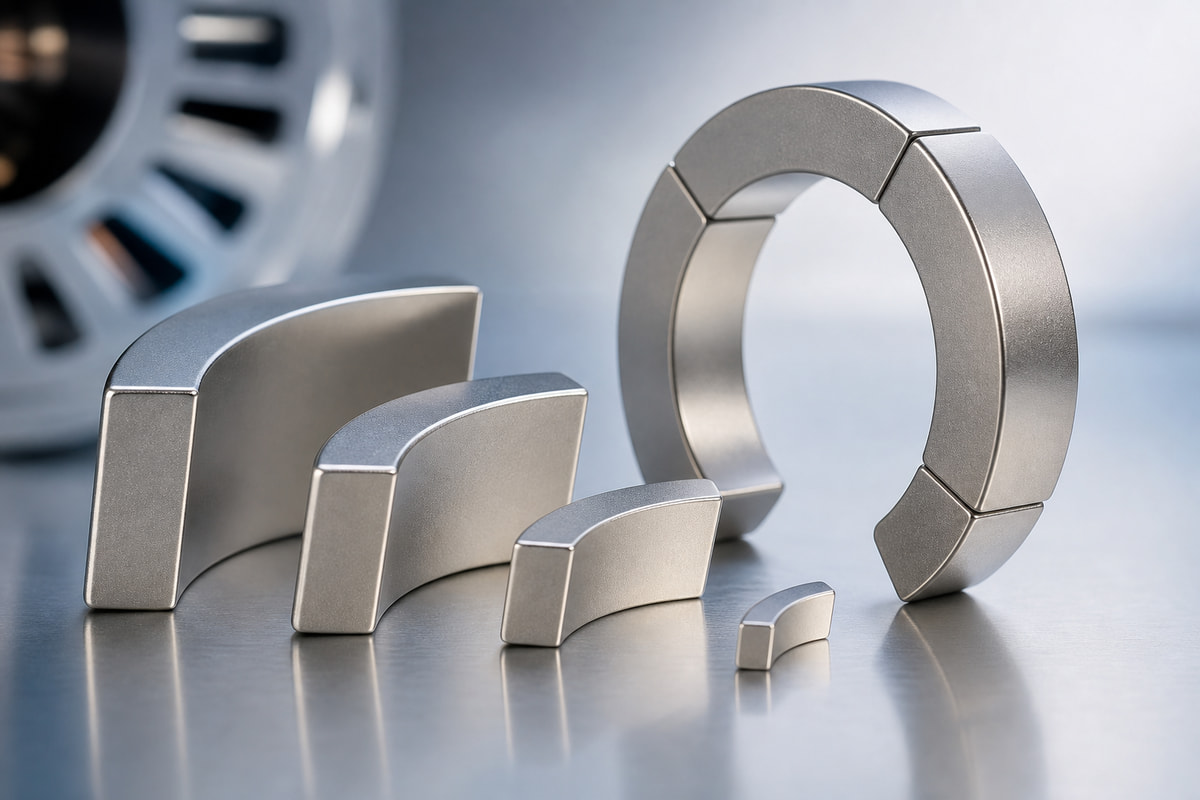
What Are Segment Magnets? The Straightforward Answer
Segment magnets go by a bunch of names: arc magnets, magnet arcs, neodymium tile magnets, or magnetic segments. No matter what you call them, the core idea is the same.
They are curved, tile-like arcs that form parts of a larger ring or cylinder. Think of them as slices of a magnetic pizza. When you put several segments together, you get a full circular magnetic circuit.
Why not just make one big ring magnet?
Good question.
The answer comes down to manufacturing. Sintered rare-earth magnets like neodymium (NdFeB) are extremely brittle and difficult to produce in large, complex ring shapes. Segmenting the magnet makes it easier to press, machine, magnetize, and assemble. It also gives you more control over the magnetic field.
That’s the #1 reason segment magnets dominate high-performance motors and generators.
Key Characteristics of Segment Magnets
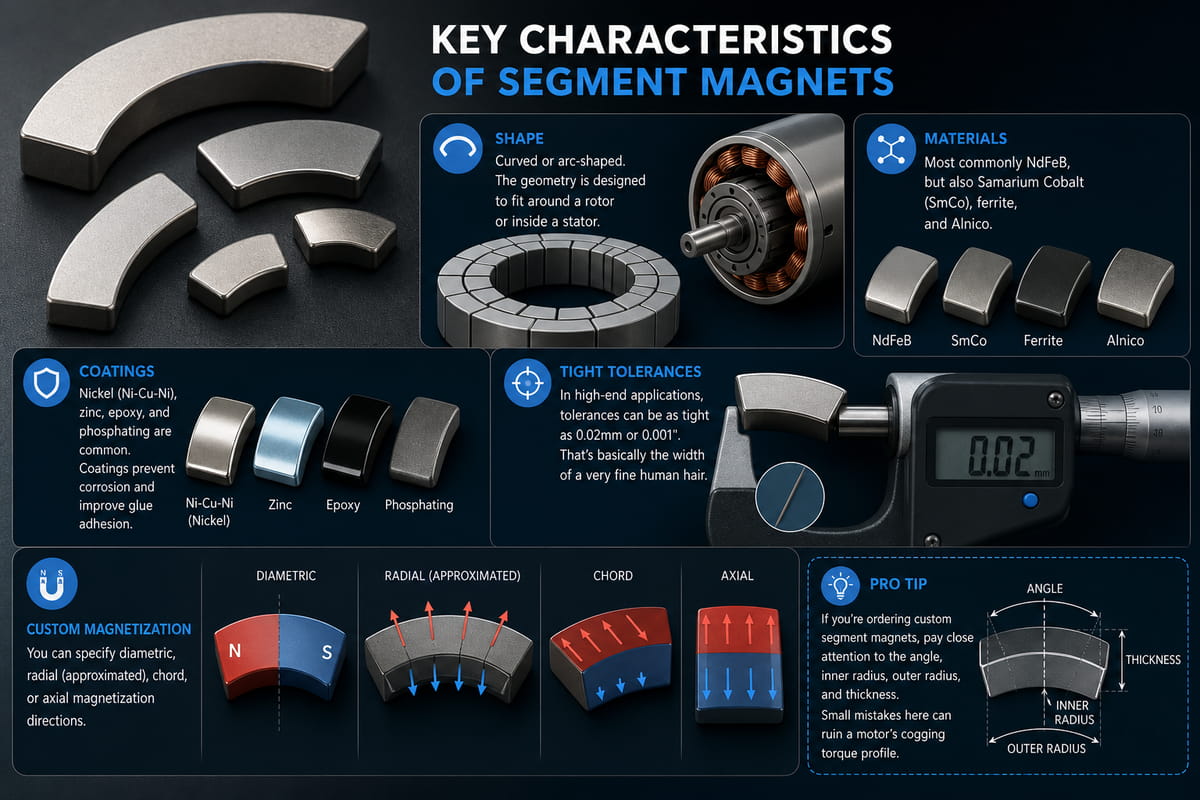
Here are the features that make segment magnets so effective.
- Shape: Curved or arc-shaped. The geometry is designed to fit around a rotor or inside a stator.
- Materials: Most commonly NdFeB, but also Samarium Cobalt (SmCo), ferrite, and Alnico.
- Coatings: Nickel (Ni-Cu-Ni), zinc, epoxy, and phosphating are common. Coatings prevent corrosion and improve glue adhesion.
- Tight tolerances: In high-end applications, tolerances can be as tight as 0.02mm or 0.001″. That’s basically the width of a very fine human hair.
- Custom magnetization: You can specify diametric, radial (approximated), chord, or axial magnetization directions.
Pro Tip: If you’re ordering custom segment magnets, pay close attention to the angle, inner radius, outer radius, and thickness. Small mistakes here can ruin a motor’s cogging torque profile.
Common Applications of Segment Magnets
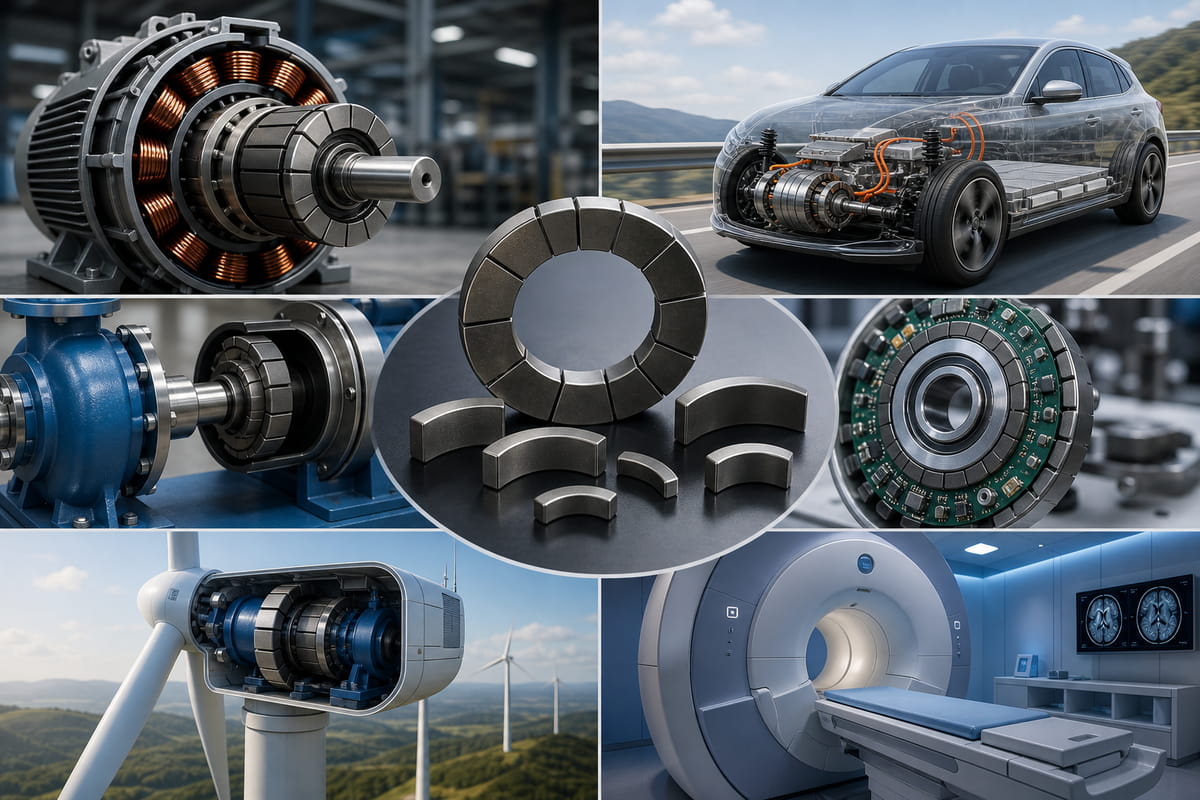
Segment magnets are everywhere—even if you don’t see them.
Electric Motors and Generators
This is the big one. Segment magnets are mounted on rotors and stators to interact with copper coils. They’re used in:
- Brushless DC motors
- Servo motors
- Stepper motors
- Permanent magnet synchronous motors (PMSMs)
- Traction motors for EVs
In 2026, electric vehicle motors remain the largest driver of demand for high-performance NdFeB segment magnets. Automakers want higher torque density, lower weight, and better efficiency. Segment magnets deliver on all three.
Magnetic Couplings
Magnetic couplings use segment magnets to transmit torque across a barrier without physical contact. This is huge for pumps handling hazardous fluids or vacuum systems where seals are a pain.
Sensors and Bearings
High-precision machinery often needs circular magnetic layouts. Segment magnets provide the exact field shape needed for sensors, magnetic bearings, and actuators.
Wind Turbines
Generators in wind turbines also rely on arc segment magnets. The curved design boosts power density and helps convert mechanical energy into electricity more efficiently.
Medical and Scientific Equipment
MRI machines, magnetic resonance imaging, and specialized research equipment use strong, stable arc magnets. Here, Samarium Cobalt segment magnets often shine because of their temperature stability.
Materials Used in Segment Magnets
Not all segment magnets are created equal. Material choice changes everything.
| Material | Strength | Max Operating Temp | Corrosion Resistance | Typical Use |
|---|---|---|---|---|
| NdFeB | Highest | 80°C–220°C (grade dependent) | Low without coating | EV motors, robotics, generators |
| SmCo | High | Up to 350°C | Excellent | Aerospace, downhole, medical |
| Ferrite | Low | ~250°C | Excellent | Cost-sensitive motors, speakers |
| Alnico | Medium | Up to 540°C | Good | Sensors, meters, high-temp |
Neodymium (NdFeB) Segment Magnets
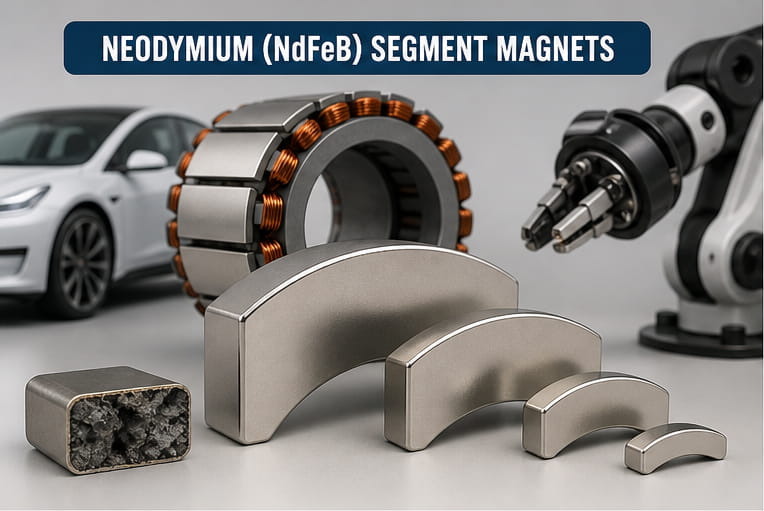
These are the most powerful permanent magnets commercially available. Grades like N42, N45SH, N48H, and N52 are common. High-coercivity grades (like N42SH or N35UH) are used when operating temperatures get hot.
Neodymium arc magnets give you maximum magnetic strength in a compact package. That’s why they dominate EV motors, robotics, and high-performance generators.
But they have a weakness: corrosion. Without proper coating, NdFeB magnets can oxidize and crumble. That’s why you’ll almost always see a nickel, epoxy, or zinc coating.
Samarium Cobalt (SmCo) Segment Magnets
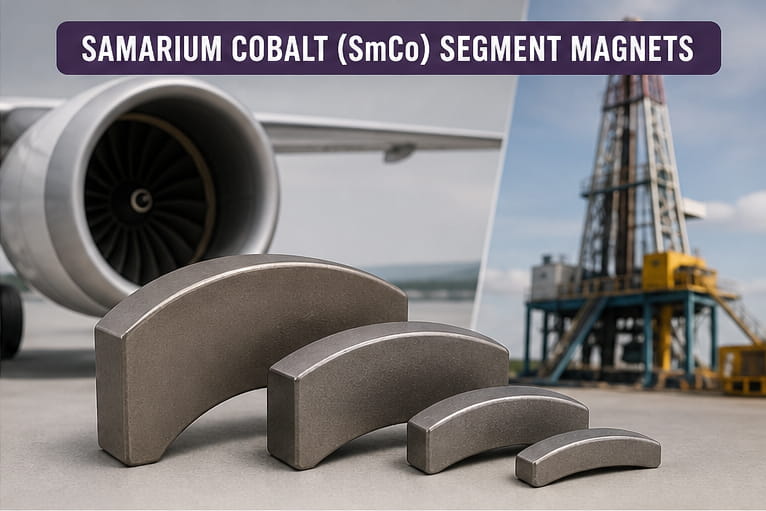
SmCo magnets aren’t as strong as NdFeB, but they win on temperature resistance and corrosion stability. If your application sees temps above 300°C—like jet engines or downhole drilling—SmCo arc magnets are the way to go.
Ferrite Segment Magnets
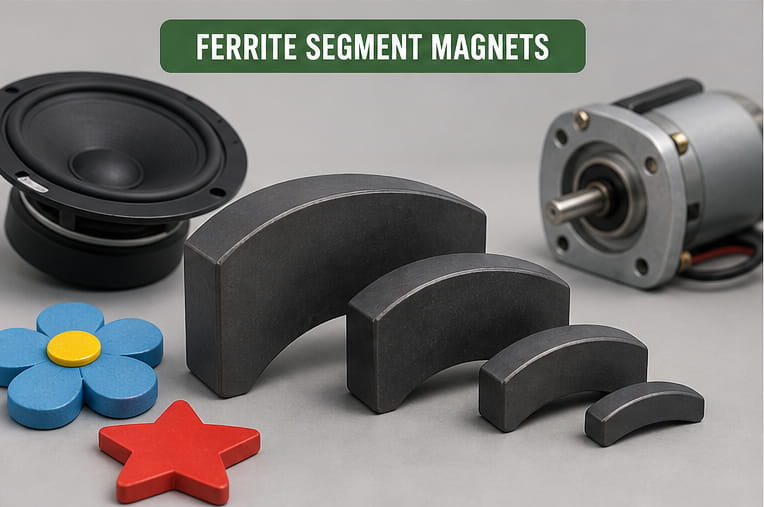
Ferrite (ceramic) magnets are much weaker. But they’re cheap, corrosion-resistant, and electrically insulating. You’ll find them in cost-sensitive motor applications, speakers, and craft projects.
Alnico Segment Magnets
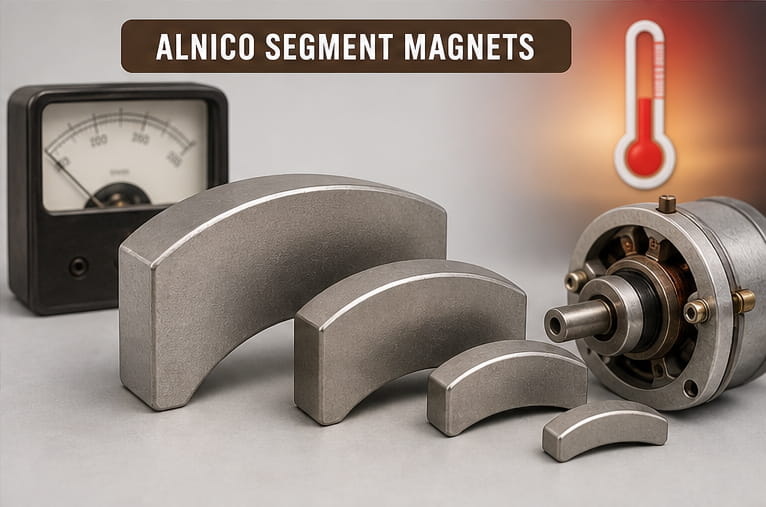
Alnico magnets have excellent temperature stability and can withstand high heat without demagnetizing. They’re used in sensors, meters, and older motor designs.
Bottom line? For most high-performance segment magnet applications in 2026, NdFeB is the default. But SmCo and ferrite still have their place.
Magnetization Direction: Why It Matters
Here’s where a lot of people get confused.
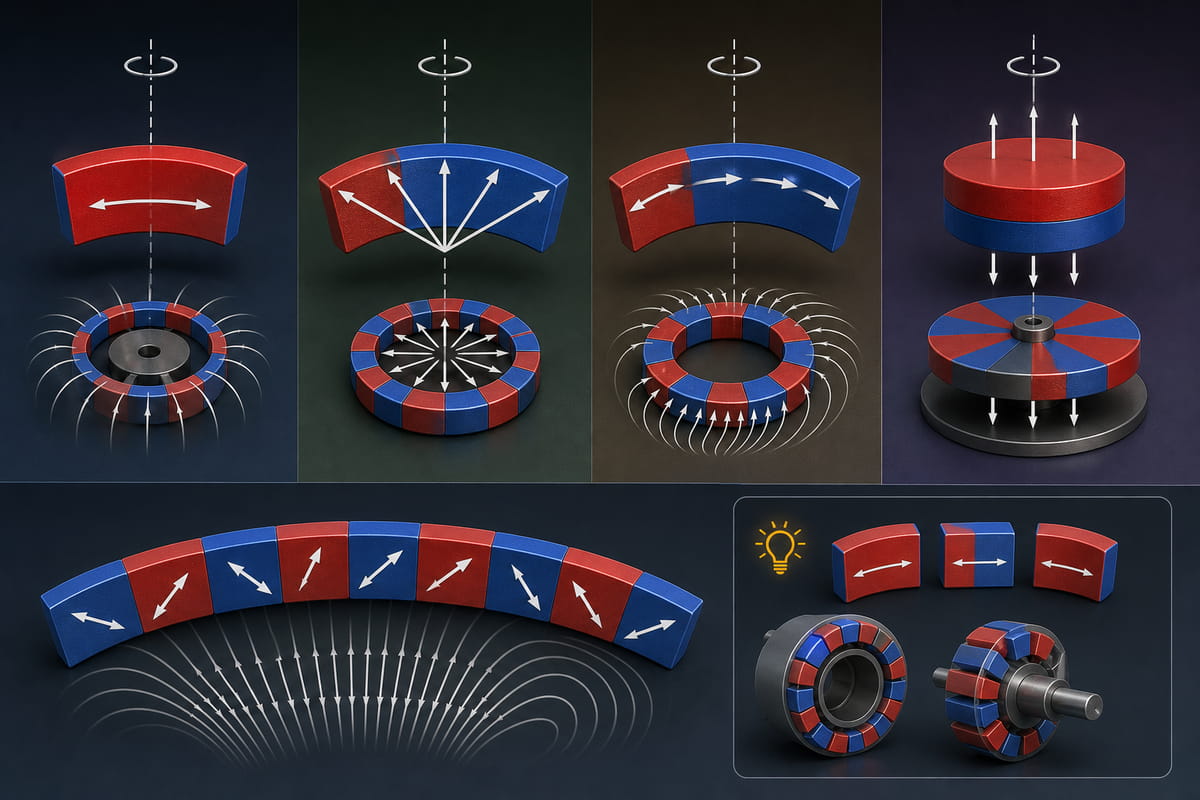
Segment magnets can be magnetized in different directions, depending on whether you’re building a radial flux or axial flux system.
- Diametrical magnetization: The magnetic field runs perpendicular to the rotation axis. This is the standard for radial flux motors and generators.
- Radial magnetization: The field points directly outward from the center. True radial magnetization is difficult to manufacture, so engineers often approximate it using multiple diametrically magnetized segments.
- Chord magnetization: Used in Halbach arrays to enhance magnetic flux on one side while canceling it on the other.
- Axial magnetization: The field runs parallel to the rotation axis. This is typical for axial flux motors and magnetic couplings.
Pro Tip: If you’re designing a Halbach array, you’ll likely need a mix of chord-magnetized and standard diametrically magnetized arc magnets. Getting the magnetization direction right is more important than raw magnet grade.
Segment Magnets vs. Bar Magnets: What’s the Difference?
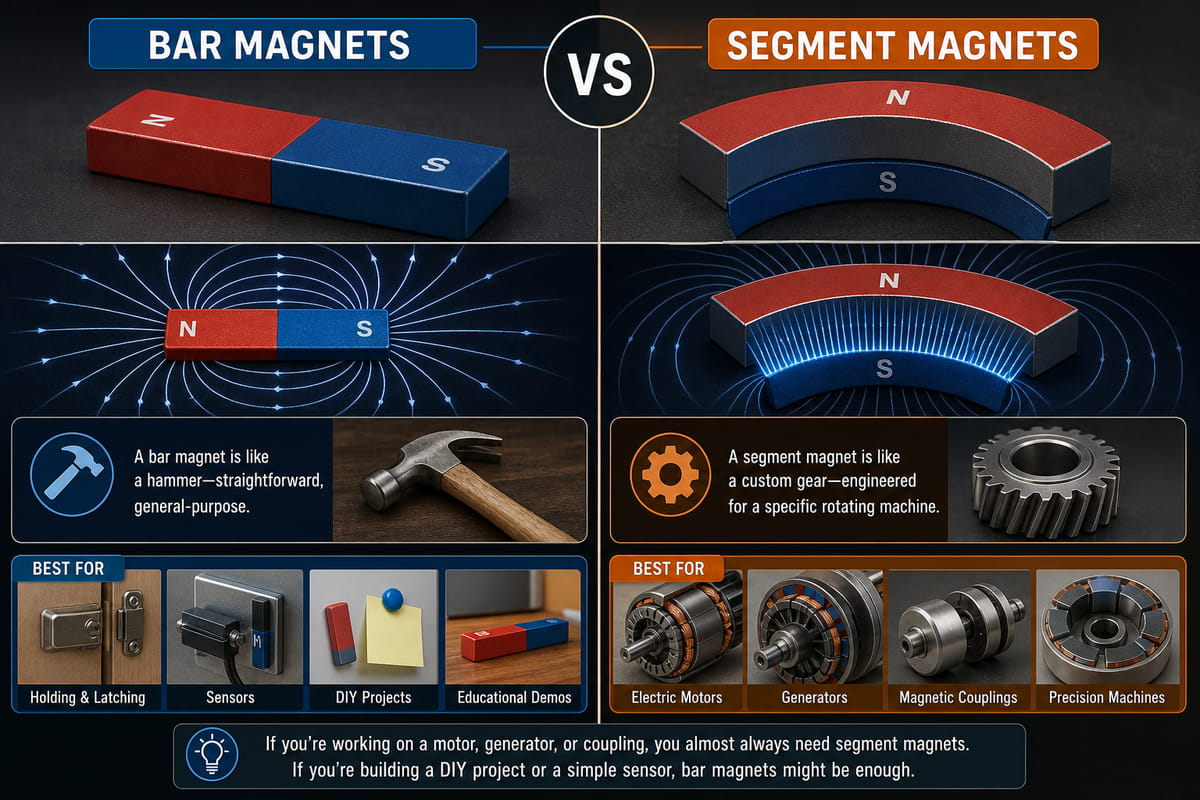
This is a question I get a lot.
Both are neodymium permanent magnets. Both are strong. But their shapes and use cases are completely different.
Bar magnets are rectangular or square blocks with a simple north-south pole. They’re great for holding, latching, sensors, and educational demos. The magnetic field is relatively straight and easy to predict.
Segment magnets are curved arcs. Their shape lets them conform to cylinders and rotors. They produce a more focused, directional magnetic field over a curved air gap. That’s why they’re the backbone of electric motors.
Here’s a simple analogy:
- A bar magnet is like a hammer—straightforward, general-purpose.
- A segment magnet is like a custom gear—engineered for a specific rotating machine.
If you’re working on a motor, generator, or coupling, you almost always need segment magnets. If you’re building a DIY project or a simple sensor, bar magnets might be enough.
How to Choose the Right Segment Magnet
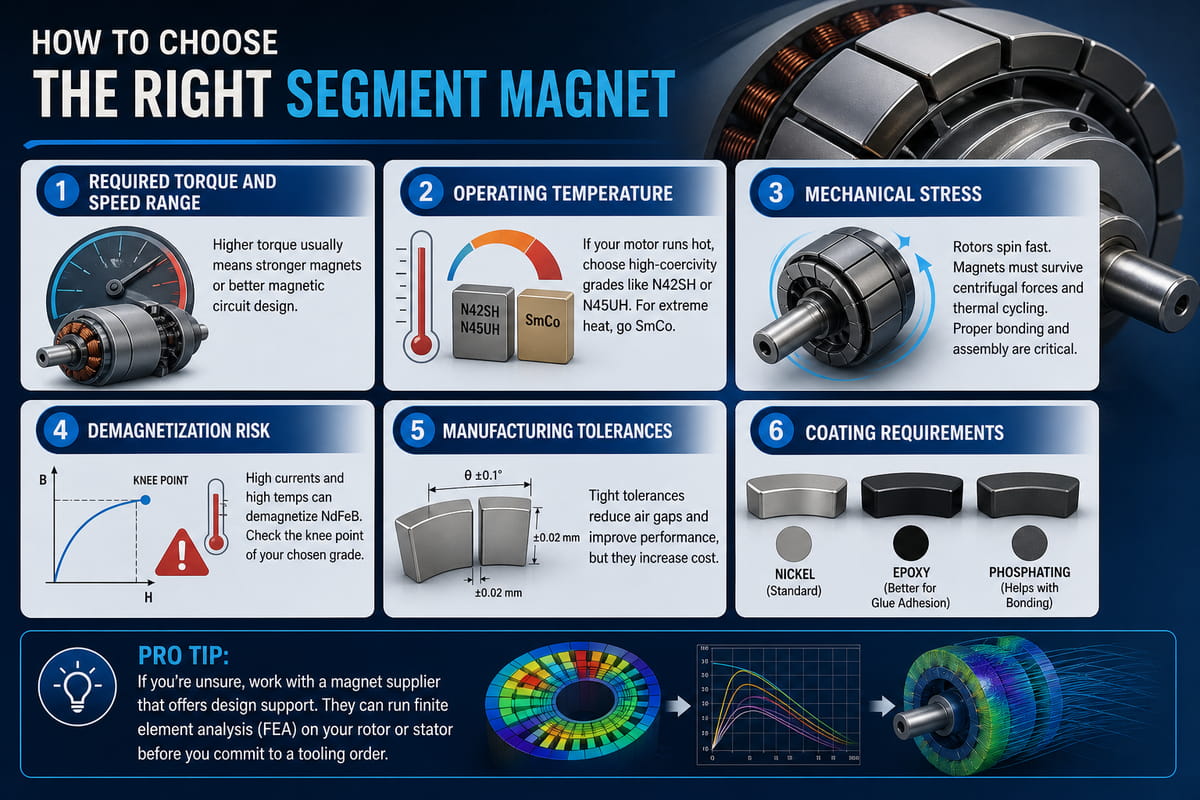
Choosing the right segment magnet isn’t just about picking the strongest grade. You need to think through these six factors:
- Required torque and speed range: Higher torque usually means stronger magnets or better magnetic circuit design.
- Operating temperature: If your motor runs hot, choose high-coercivity grades like N42SH or N45UH. For extreme heat, go SmCo.
- Mechanical stress: Rotors spin fast. Magnets must survive centrifugal forces and thermal cycling. Proper bonding and assembly are critical.
- Demagnetization risk: High currents and high temps can demagnetize NdFeB. Check the knee point of your chosen grade.
- Manufacturing tolerances: Tight tolerances reduce air gaps and improve performance, but they increase cost.
- Coating requirements: Nickel is standard. Epoxy is better for glue adhesion. Phosphating also helps with bonding.
Pro Tip: If you’re unsure, work with a magnet supplier that offers design support. They can run finite element analysis (FEA) on your rotor or stator before you commit to a tooling order.
Segment Magnet Manufacturing: A Quick Overview
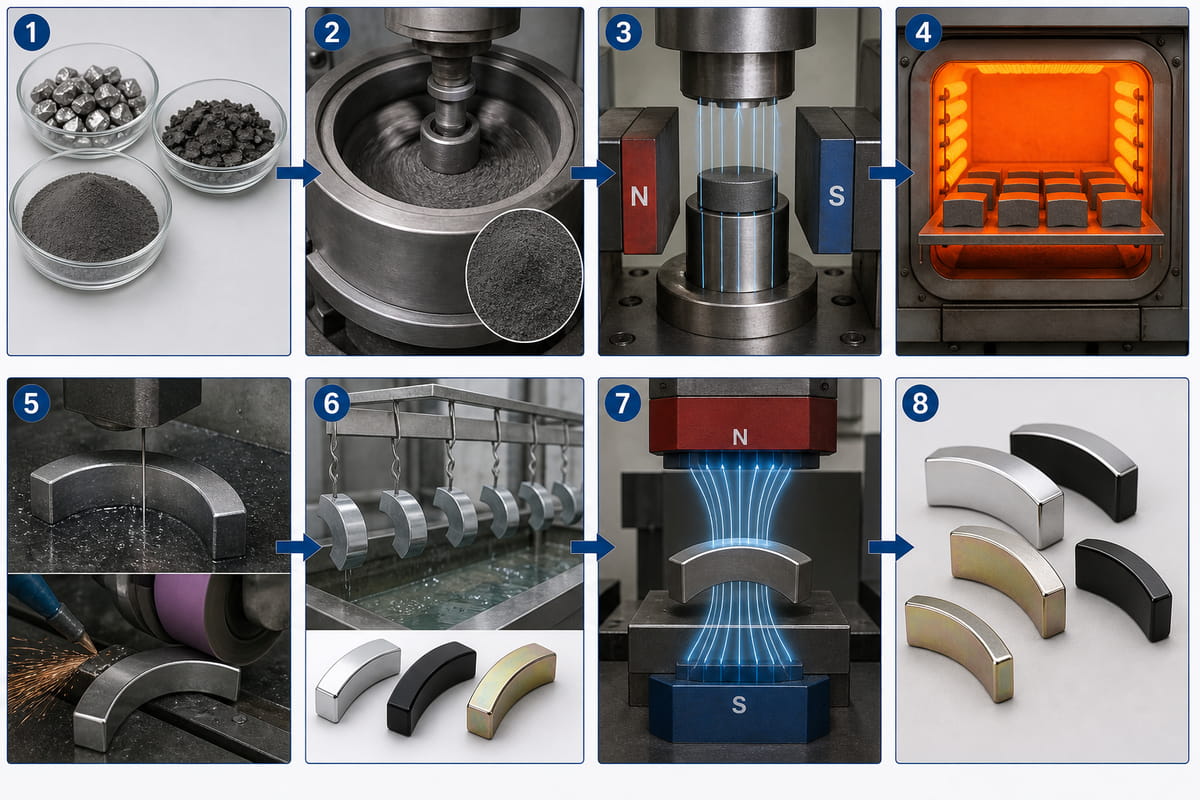
Are you wonder how these segment magnets are made? Here’s the short version:
- Material selection: Mixing neodymium, iron, and boron in precise ratios.
- Milling: Grinding the alloy into a fine powder.
- Pressing: Compacting the powder in a magnetic field to align magnetic domains.
- Sintering: Fusing the particles at high temperatures to create a dense magnet blank.
- Machining: Cutting or grinding the blank into the arc shape. Wire cutting is common for complex shapes; profile grinding works for large batches.
- Coating: Applying nickel, epoxy, or zinc to prevent corrosion.
- Magnetization: Exposing the finished magnet to a strong magnetic field to set the direction.
Step #5 is the tricky part. Because NdFeB is brittle, machining arc magnets requires special care. That’s why tight tolerances and chamfers cost extra.
Segment Magnet Efficiency and Cogging Torque
Here’s a technical concept worth understanding.
In slotted motors, the interaction between magnets and stator teeth causes cogging torque. That creates torque ripple, vibration, and noise. It reduces smoothness and hurts efficiency.
Segment magnets help fix this.
By using skewed or specially shaped arc segments, motor designers can minimize cogging. That means smoother operation and better overall performance.
Another challenge is eddy current loss. When a motor runs, changing magnetic fields induce currents in the magnets. Those currents generate heat. Too much heat and you risk demagnetization.
The solution? Laminated arc magnets. These are made of thin bonded layers. They reduce eddy current losses without changing the motor’s structure. In 2026, laminated segment magnets are becoming a go-to choice for high-speed motors.
2026 Trends in Segment Magnet Technology
The magnet industry doesn’t stand still. Here’s what I’m watching in 2026.
1. Higher energy density magnets
Research into new alloys and process controls is pushing NdFeB grades higher. N52 and above are becoming more commercially viable.
2. Reduced rare-earth usage
Cost and supply chain pressure are driving designers to use less neodymium. Laminated arc magnets and optimized rotor geometries help achieve similar performance with fewer rare earths.
3. Improved thermal resilience
High-coercivity grades and better grain boundary diffusion processes are extending the operating temperature range of NdFeB segment magnets.
4. Halbach array adoption
Halbach arrays aren’t new, but they’re gaining traction in aerospace, robotics, and high-efficiency motors. They offer higher air gap flux density and lower harmonic distortion.
5. Competitive sourcing and supply chain shifts
As of 2026, many manufacturers are diversifying away from single-source rare earth supply chains. This affects pricing, lead times, and material availability.
Common Mistakes to Avoid
Let me save you some expensive pain.
- Ignoring magnetization direction: Wrong direction = weak motor. Period.
- Skipping coating: Bare NdFeB magnets will corrode fast, especially in humid environments.
- Underestimating heat: High temps can permanently demagnetize standard N grades. Use SH, UH, or EH grades when needed.
- Poor bonding: If magnets fly off a rotor at 10,000 RPM, the whole assembly fails. Use the right adhesive and surface prep.
- Forgetting tolerances: A 0.1mm air gap increase can drop motor efficiency by several percent. Pay for precision.
Real-World Example: Why Segment Magnets Win in EV Motors
Here’s a quick case study from my experience working with motor manufacturers.
A client came to us with a rotor design that used a single large ring magnet. It was expensive to make and hard to magnetize. By switching to 24 segment magnets arranged in a ring, they:
- Reduced manufacturing cost by 18%
- Improved magnetic field uniformity by 12%
- Simplified assembly and replacement
The result? A more efficient motor that was easier to build.
That’s the power of segmentation.
Conclusion
So, what are segment magnets? They’re the curved, arc-shaped building blocks that make high-performance rotating machinery possible. From EV motors to wind turbines, these magnets deliver strong, focused magnetic fields in geometries that single-piece magnets can’t match.
If you’re designing a motor, generator, or coupling in 2026, understanding segment magnets is non-negotiable. Start with the material, nail the magnetization direction, and don’t forget the coating.
Ready to take the next step? Check out my complete guide to magnet selection—or contact a supplier that can help you run FEA on your design.
Because at the end of the day, the right segment magnet doesn’t just improve performance. It gives you an edge.


