
Quick Summary:
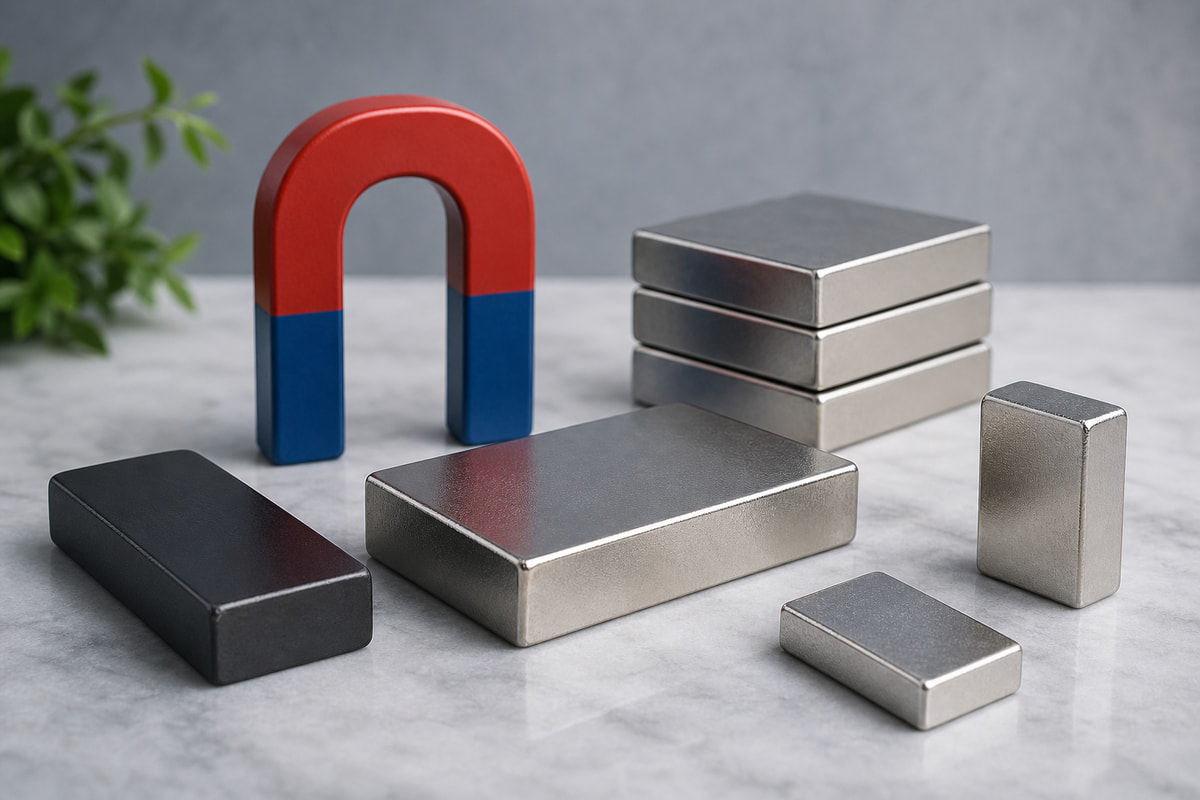
Block magnets are six-sided permanent magnets with rectangular, square, or cube shapes that produce a constant magnetic field. Their flat shape creates more surface contact with metal, which means stronger holding force than disc magnets of the same thickness.
- Neodymium block magnets are the strongest commercially available but require protective coatings and can’t handle high temperatures, while ceramic block magnets are more affordable and heat-resistant.
- When choosing a block magnet, check pull force, grade, dimensions, coating, mounting style, and temperature rating—and remember that minimizing the air gap between the magnet and clean, bare steel is the single biggest factor in real-world performance.
You’re probably here because you’ve been burned before. You picked a magnet for a project, and it just didn’t hold. Maybe it was too weak for the job. Maybe it corroded in a damp environment. Or maybe you reached for a disc magnet when a rectangular one would have worked far better. It’s frustrating, right? Choosing the wrong magnet wastes time, money, and can even be dangerous when parts snap together unexpectedly.
The good news is that block magnets—six-sided permanent magnets with a rectangular, square, or cube shape—are one of the most reliable options you can choose. Their flat surfaces create more contact area with metal, which means more holding force.
In this guide, as a professional custom block magnets manufacturer, I will explain what block magnets are, the different materials they’re made from (including neodymium and ceramic), where they’re used around the house, in workshops, and in industrial settings, plus exactly how to select the right one for your specific application—without making the mistakes most beginners make.
Why Magnet’s Shape Matters
You probably think a magnet’s strength comes from its material. That’s true.
But shape matters just as much.
Block magnets have flat surfaces. And flat surfaces create more contact area with the metal you want to hold. When a magnet has more surface area touching a ferromagnetic object, it produces more holding force.
Think about it this way: if you press your hand flat against a table, it’s hard to pull you away. If you touch it with one finger, it’s easy. Same with magnets. More contact equals more grip.
That’s why block magnets are ideal for clamping, mounting, and anything that needs maximum friction.
Disc magnets are good. But for holding flat objects, block magnets usually win. The rectangular footprint spreads the magnetic field over a larger area. This makes them more efficient for attaching to flat metal surfaces. If you’re mounting a magnet to a door frame or a tool rack, a block magnet gives you more contact. It’s that simple.
Poles and Magnetization Direction
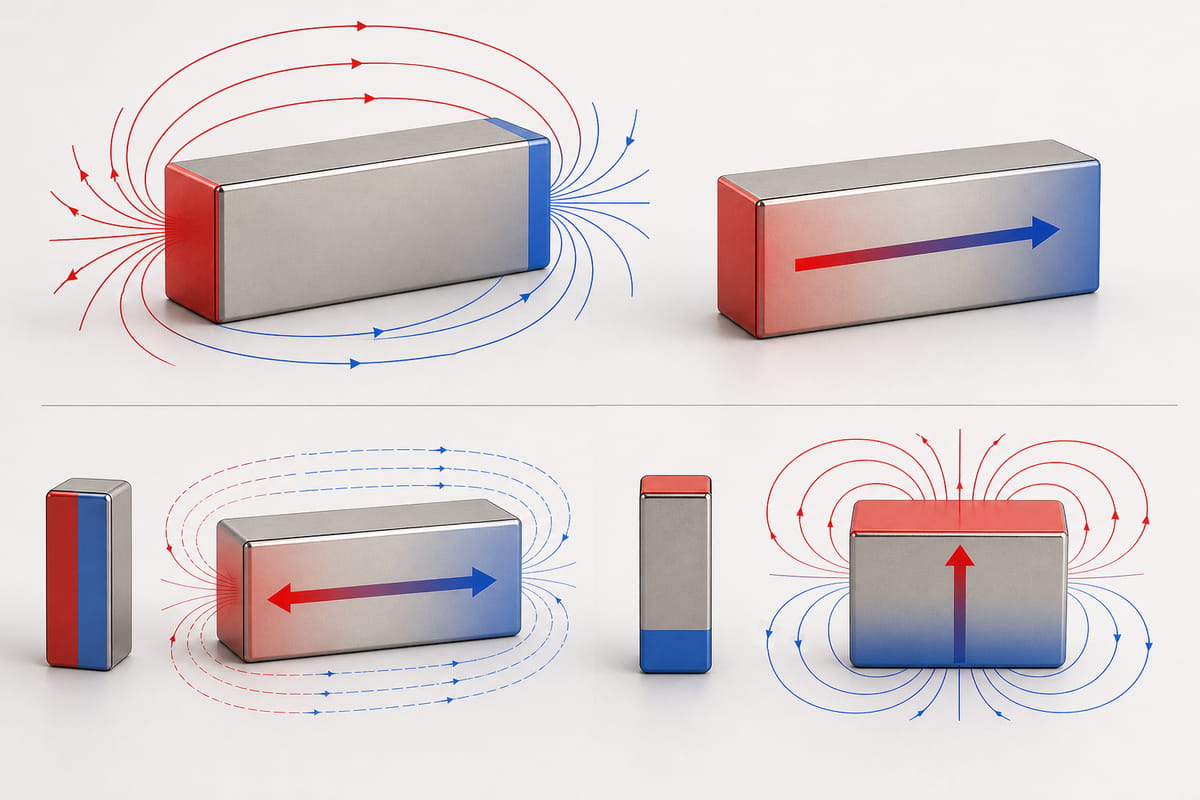
Every block magnet has a north pole and a south pole. In most block magnets, the poles are on opposite flat ends. That means the large flat faces are the strongest parts of the magnet.
But that’s not always true. Some block magnets are magnetized through the length or width. This is called diametric magnetization. It’s less common, but it’s used in special sensor and levitation applications.
Here’s why this matters: if you’re assembling a magnetic system, you need to know the direction of the magnetic field. The pole orientation determines how the magnet attracts or repels another magnet.
I’ve seen people install block magnets backwards. The result is a system that pushes parts away instead of holding them. So check the pole orientation before you design the assembly.
The Main Types of Block Magnets
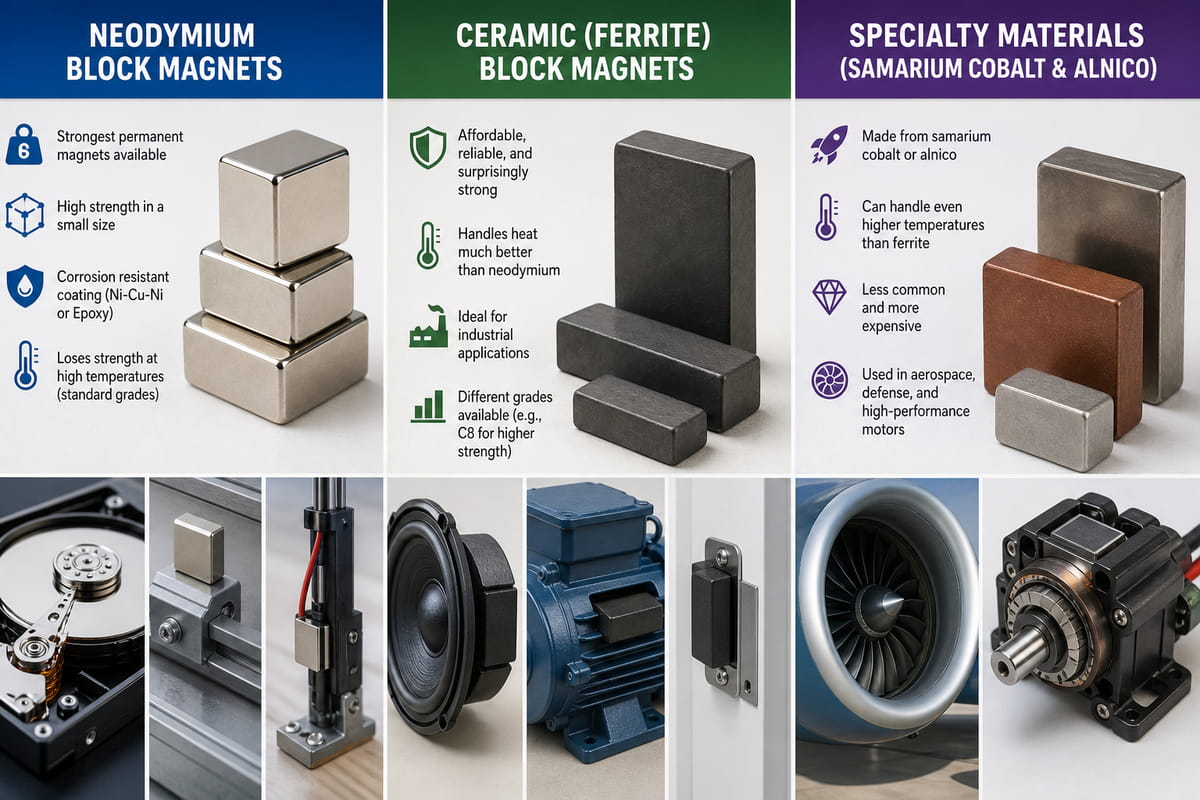
Now, not all block magnets are the same. The material makes a huge difference.
Neodymium Block Magnets
Neodymium block magnets are rare earth magnets. They’re made from an alloy of neodymium, iron, and boron (NdFeB). They’re the strongest permanent magnets commercially available today.
I personally use neodymium blocks in projects where space is tight and holding power is non-negotiable. A small neodymium block can hold much more weight than a much larger ceramic magnet.
But there’s a tradeoff. Neodymium can corrode in moist environments. Most are coated with a nickel-copper-nickel finish. You can also get an epoxy coating for extra protection. And standard neodymium magnets start losing strength when temperatures get too high. For high heat, you need specialty grades.
Ceramic Block Magnets
Ceramic block magnets, also known as ferrite magnets, are the workhorses of the magnet world. They’re made from iron oxide and strontium carbonate. They’re affordable, reliable, and surprisingly strong.
They’re not as strong as neodymium. But they handle heat much better. So for industrial applications where the magnet needs to survive tough conditions, ceramic is often a smart choice.
There are different ceramic grades too. C8, for example, is known for having superior magnetic strength.
Specialty Materials
There are also block magnets made from samarium cobalt and alnico. These are less common. They’re expensive. But they can handle even higher temperatures than ferrite. If you’re working on aerospace or high-performance motors, you may need one of these.
For everyone else, neodymium and ceramic are the way to go.
Where Block Magnets Are Used

Block magnets show up in more places than you might realize. Let’s break it down.
Around the House
- Cabinet latches
- Door latches
- Magnetic knife racks
- Magnetic tool bars
- Fridge magnets
- Jewelry clasps
I’ve used block magnets to make a magnetic spice rack. Took me an afternoon. It’s been holding strong for three years.
In the Workshop
- Clamping and workholding
- Jigs and fixtures
- Pickup tools
- Holding metal parts while you drill
A simple magnetic block can be a game changer in a small workshop. I built a jig for my table saw using two neodymium blocks and a steel plate. It wasn’t fancy. It worked perfectly. The flat magnet surface gave me a precise, repeatable setup every time.
Industrial and Commercial
- Electric motors
- Sensors
- Speakers
- Magnetic separators
- Generators
- Robotics
- Conveyor systems
- Water treatment devices
In industrial settings, block magnets are often used to pull metal debris out of production lines. This is called magnetic separation. It keeps contaminant and metal fragments out of food, chemicals, and other products.
Block magnets are also common in water purification systems. They help capture heavy metals, mineral salts, and scale. It’s one of those use cases most people never think about.
Electronics and Automation
The rectangular shape of a block magnet is perfect for sensors and precision systems. It provides a uniform magnetic field across a flat surface. That consistency is critical in automation and electronics.
If you’ve ever taken apart a phone speaker or a small motor, you’ve probably seen block magnets inside. They’re everywhere.
How to Choose a Block Magnet
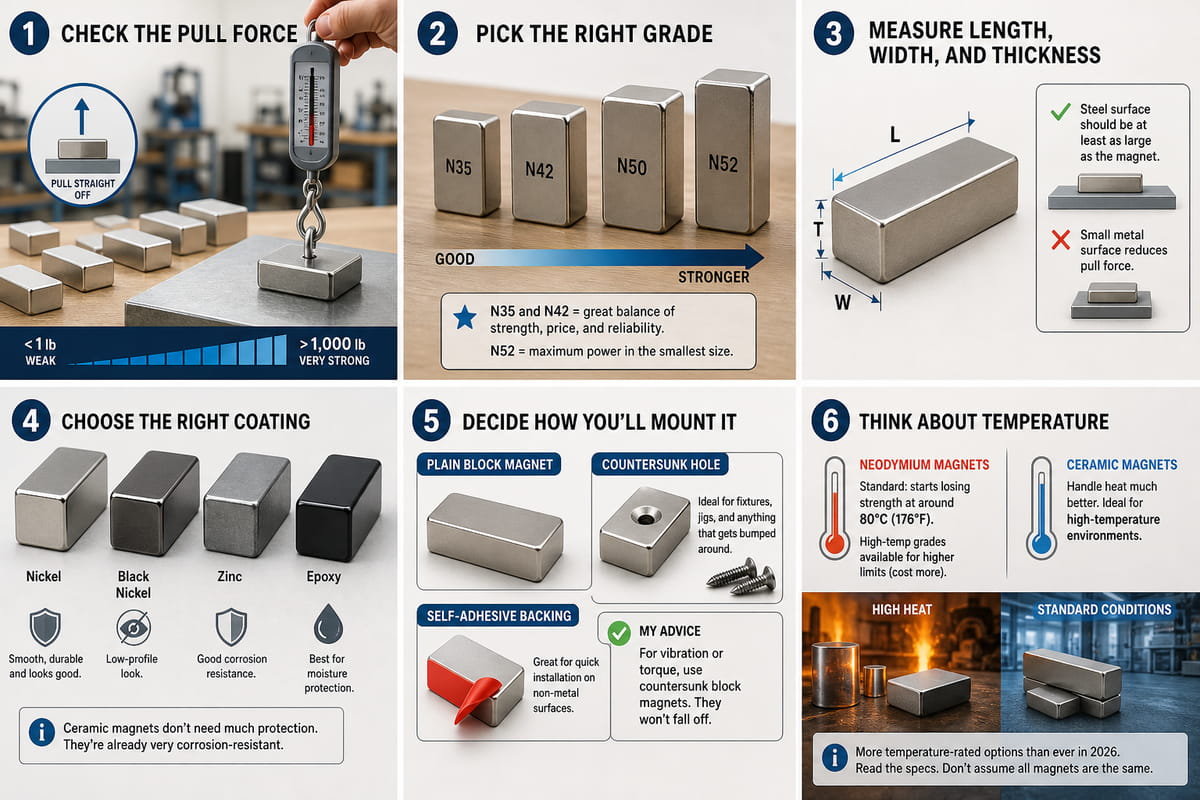
Alright, so you need a block magnet. What matters most? Let me give you a simple process.
1. Check the Pull Force
Pull force is the amount of force needed to pull a magnet straight off a thick piece of steel. It’s the most practical number a magnet seller can give you.
Don’t guess based on size. Always check the pull force.
Here’s the deal: block magnets come in a massive range of strengths. Some have a pull force of less than a pound. Others can pull over 1,000 pounds. You need to match the magnet to the job.
Pull force ratings are measured under ideal conditions. In reality, a magnet’s performance depends on how you use it. Pulling straight off a surface is different from sliding a magnet sideways. The straight pull is always lower than the sliding force. So if your project will experience side loads, choose a magnet with extra holding force.
Here’s a quick way to test a block magnet: place it against a thick, clean steel plate. Pull it straight off with a spring scale. That gives you the actual pull force. This is exactly how suppliers test magnets. If you don’t have a spring scale, start with a small weight and increase until the magnet slips.
2. Pick the Right Grade
For neodymium magnets, you’ll see grades like N35, N42, N50, and N52. The higher the number, the stronger the magnetic field.
For most projects, N35 and N42 are a sweet spot. They’re strong, affordable, and reliable. N52 is the premium option. It’s for when you need maximum power in the smallest possible size.
But higher grade doesn’t mean “better” in every way. It can be more brittle and more expensive. Use the right grade for your application.
3. Measure Length, Width, and Thickness
Block magnets are usually sold by length x width x thickness. That’s the measurement system you’ll see in most online stores.
Why does this matter? Because you need the magnet to fit in your design. A magnet that’s too thick may not fit in a small space. A magnet that’s too thin may not deliver enough holding force.
Also, keep in mind that the metal surface you’re attaching to should be at least as large as the magnet. A huge magnet on a thin piece of metal won’t reach its rated pull force.
4. Choose the Right Coating
Neodymium block magnets need protection. The standard coating is nickel. It’s smooth, durable, and looks good.
If the magnet will be around moisture, choose an epoxy coating. Epoxy is more corrosion-resistant than nickel. If you need a low-profile look, black nickel or zinc coatings are available.
Ceramic magnets don’t need much protection. They’re already very corrosion-resistant.
5. Decide How You’ll Mount It
Do you need a plain magnet? Or one with a countersunk hole?
Countersunk holes are a big deal. They let you attach the magnet to a surface with a screw. That’s ideal for fixtures, jigs, and anything that will get bumped around.
Some block magnets come with self-adhesive backing. These are great for quickly sticking a magnet to a non-metal surface. But adhesive can fail over time. For a permanent installation, a screw-mounted magnet is better.
My advice? If you’re building something that will experience vibration or torque, use countersunk block magnets. They won’t fall off.
6. Think About Temperature
This is a common trap.
Standard neodymium magnets start losing strength at around 80°C (176°F). High-temperature grades can go higher, but they cost more.
Ceramic magnets handle heat much better. If you’re working in a hot environment, ceramic is usually the smarter option.
If you’re shopping in 2026, you’ll find more temperature-rated options than ever before. Read the specs. Don’t assume all magnets are the same.
Pro Tips for Getting the Most Out of Block Magnets
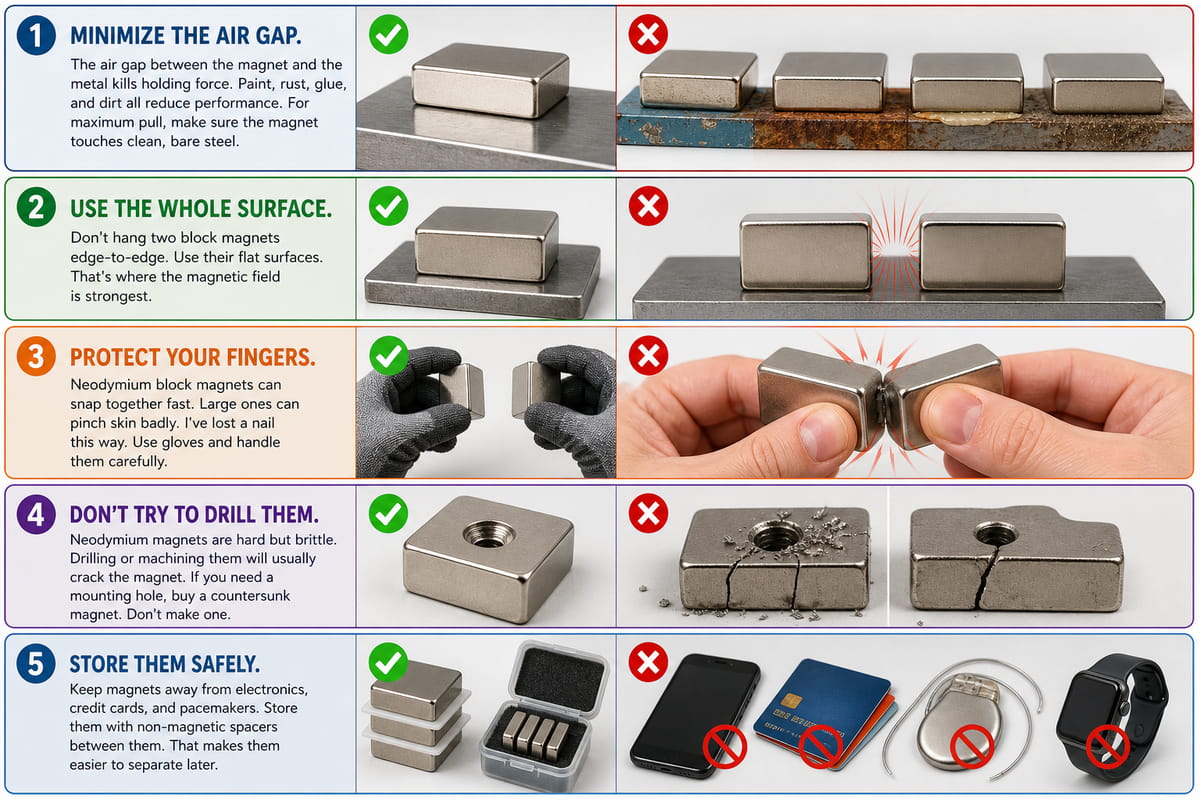
Let me leave you with a few things I’ve learned from using these things.
Pro Tip #1: Minimize the air gap.
The air gap between the magnet and the metal kills holding force. Paint, rust, glue, and dirt all reduce performance. For maximum pull, make sure the magnet touches clean, bare steel.
Pro Tip #2: Use the whole surface.
Don’t hang two block magnets edge-to-edge. Use their flat surfaces. That’s where the magnetic field is strongest.
Pro Tip #3: Protect your fingers.
Neodymium block magnets can snap together fast. Large ones can pinch skin badly. I’ve lost a nail this way. Use gloves and handle them carefully.
Pro Tip #4: Don’t try to drill them.
Neodymium magnets are hard but brittle. Drilling or machining them will usually crack the magnet. If you need a mounting hole, buy a countersunk magnet. Don’t make one.
Pro Tip #5: Store them safely.
Keep magnets away from electronics, credit cards, and pacemakers. Store them with non-magnetic spacers between them. That makes them easier to separate later.
Are Block Magnets Right for You?
Let’s be honest. Block magnets aren’t the most glamorous product in the world. But they’re incredibly useful.
Need to hold a steel workpiece while you weld? A block magnet can do that.
Need a sensor to detect position in a machine? A block magnet can do that.
Need to organize your kitchen? A block magnet can do that too.
Their combination of strength, flatness, and versatility makes them one of the best all-around magnet shapes.
Conclusion
So, what are block magnets? Let’s bring it all together.
Block magnets are six-sided permanent magnets with a rectangular, square, or cube shape. They produce a constant magnetic field. Their flat surfaces give them high holding force on metal surfaces. They come in strong neodymium, affordable ceramic, and specialty materials.
You’ll find block magnets in your kitchen, your workshop, your car, and thousands of industrial machines. They’re simple, reliable, and often the best choice for holding, clamping, sensing, and separating.
In short, what are block magnets? They’re one of the most useful tools you’ll ever have.


