
Quick Summary:
- N52 magnets are roughly 20–24% stronger than N42 in the same size, but they cost 35–50% more and have a lower maximum operating temperature (60–65°C vs. 80°C).
- N42 is the reliable, cost-effective workhorse for general industrial use, while N52 is best when space or weight is extremely tight and temperatures stay cool.
- If you’re unsure, go with N42—you can almost always match N52 performance by using a slightly larger magnet and save money.
You’re trying to pick between N52 and N42 magnets. Maybe you’re building a prototype, designing a motor, or just need something to hold a heavy toolbox to the wall. Most people assume “N52 is better because it’s stronger.” Not so fast.
N52 packs 20–24% more pull force in the same size, but it’s also more expensive, more sensitive to heat, and slightly more brittle. N42 handles temperatures up to 80°C, costs less, and is widely available. The wrong choice can mean wasted money, weak performance, or even magnet failure.
In this guide, as a professional custom N52 magnets and N42 magnets manufacturer, I will break down the real differences—strength, temperature limits, cost, durability—and give you a simple framework to pick the right grade for your project.
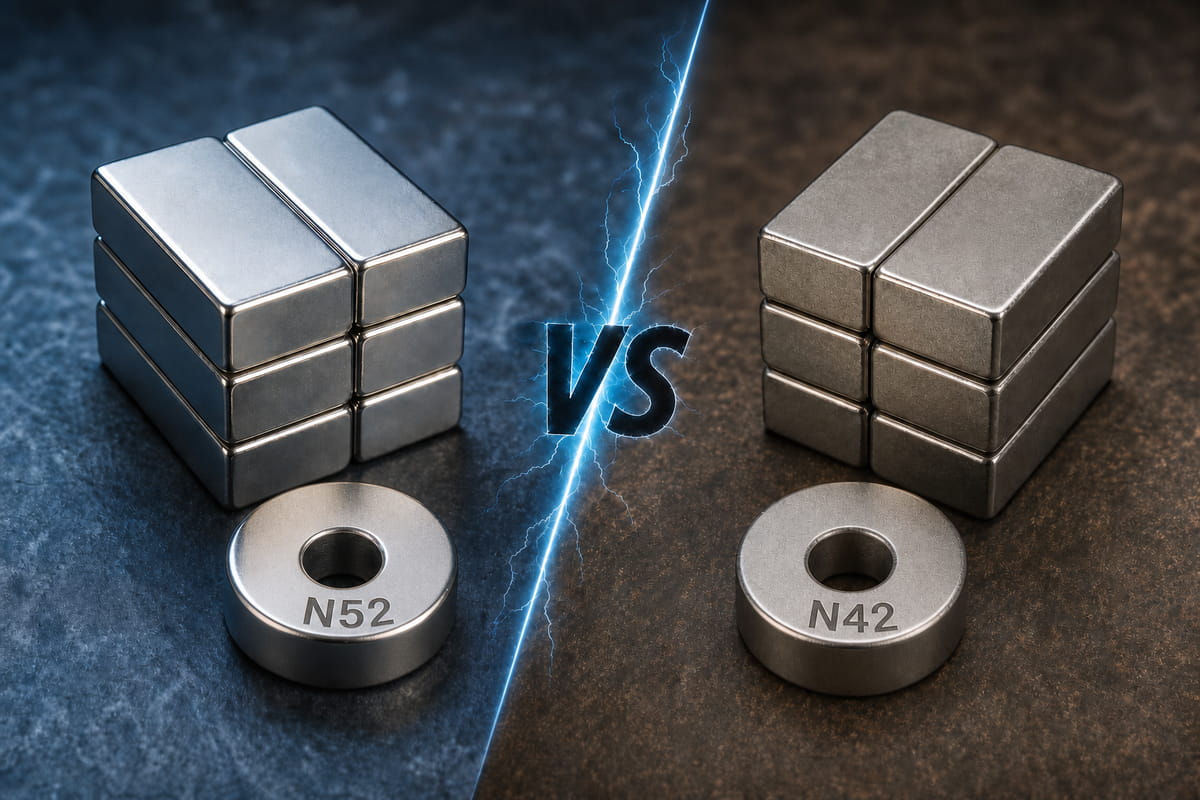
The Magnet Grades System Explained
First, a quick primer.
The “N” stands for Neodymium.
The number? That’s the magnet’s Maximum Energy Product—measured in Mega-Gauss Oersteds (MGOe).
Basically: the higher the number, the more magnetic energy packed into that little chunk of metal.
- N42: ~42 MGOe
- N52: ~52 MGOe
Simple enough, right?
But here’s where it gets interesting: that 10 MGOe difference translates to about 20-24% more pull force in N52.
Let me show you what that looks like in the real world.
N52 vs n42 Magnets: The Core Differences
1. Magnetic Strength
This is the obvious one.
N52 is stronger. Period.
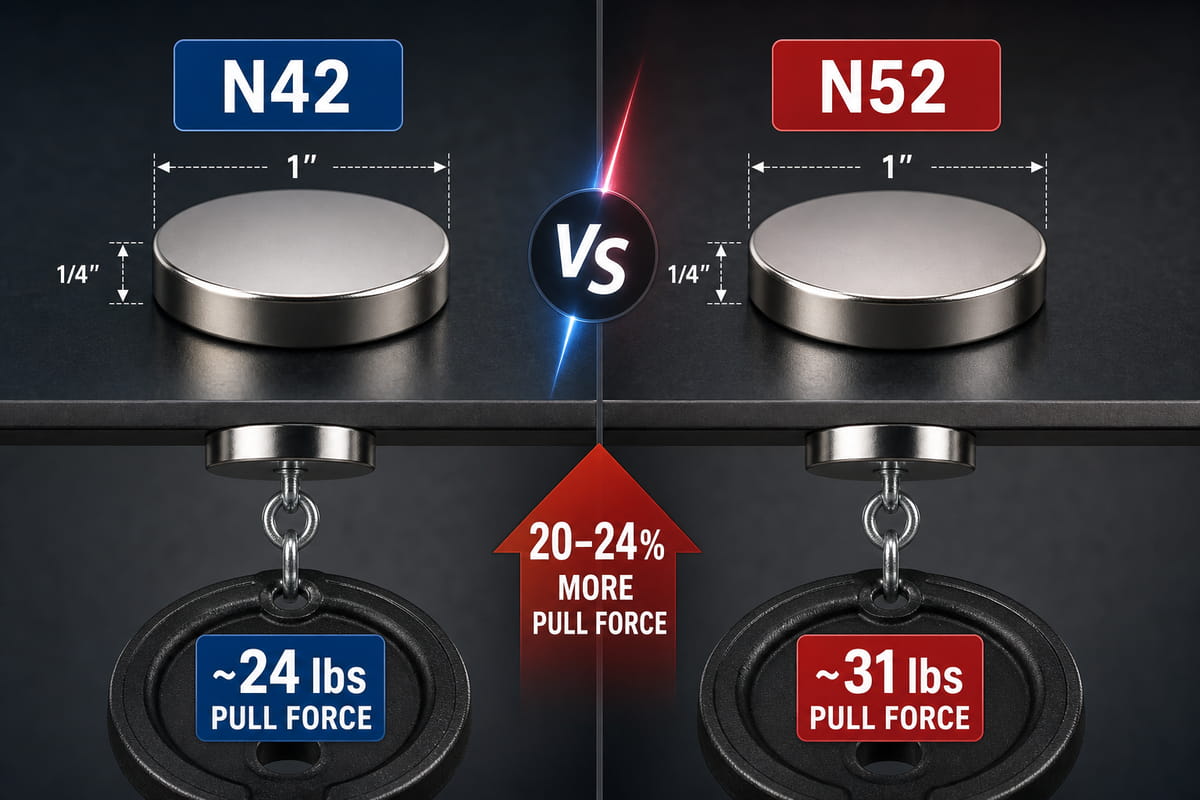
In identical sizes and shapes, an N52 magnet will give you roughly 20-24% more pull force than an N42.
Here’s a real example:
Take a standard 1″ x 1/4″ disc magnet.
- N42: ~24 lbs pull force
- N52: ~31 lbs pull force
That’s a 7-pound difference. In a magnet the size of a quarter.
Pro Tip: If you’re tight on space, N52 lets you use a physically smaller magnet to get the same holding power as a larger N42 magnet. That’s huge for compact electronics or precision instruments.
2. Temperature Resistance
This is where most people get tripped up.
You’d think “stronger = better at everything.” But that’s not how magnets work.
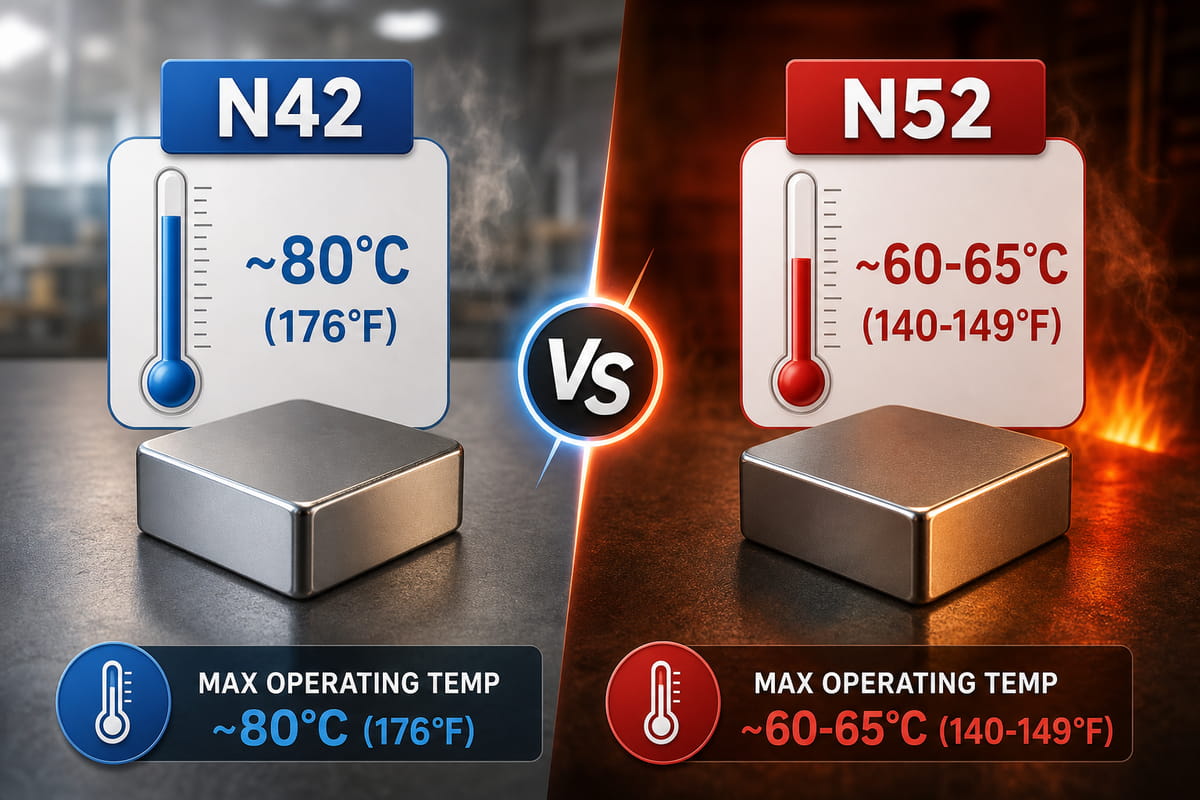
N42 actually handles heat better than N52.
Here’s the breakdown:
| Grade | Max Operating Temp |
|---|---|
| N42 | ~80°C (176°F) |
| N52 | ~60-65°C (140-149°F) |
Why?
Because N52 pushes the material to its physical limits. The higher energy density makes it more sensitive to thermal stress.
So if your magnet’s going to be near a motor, in direct sunlight, or anywhere warm, N42 magnet might actually be the smarter choice.
But here’s the thing: if you need high heat resistance AND high strength, look for specialty grades like N42SH or N52H. These use additives (dysprosium, terbium) to fight thermal degradation. They cost more, but they work.
3. Durability and Brittleness
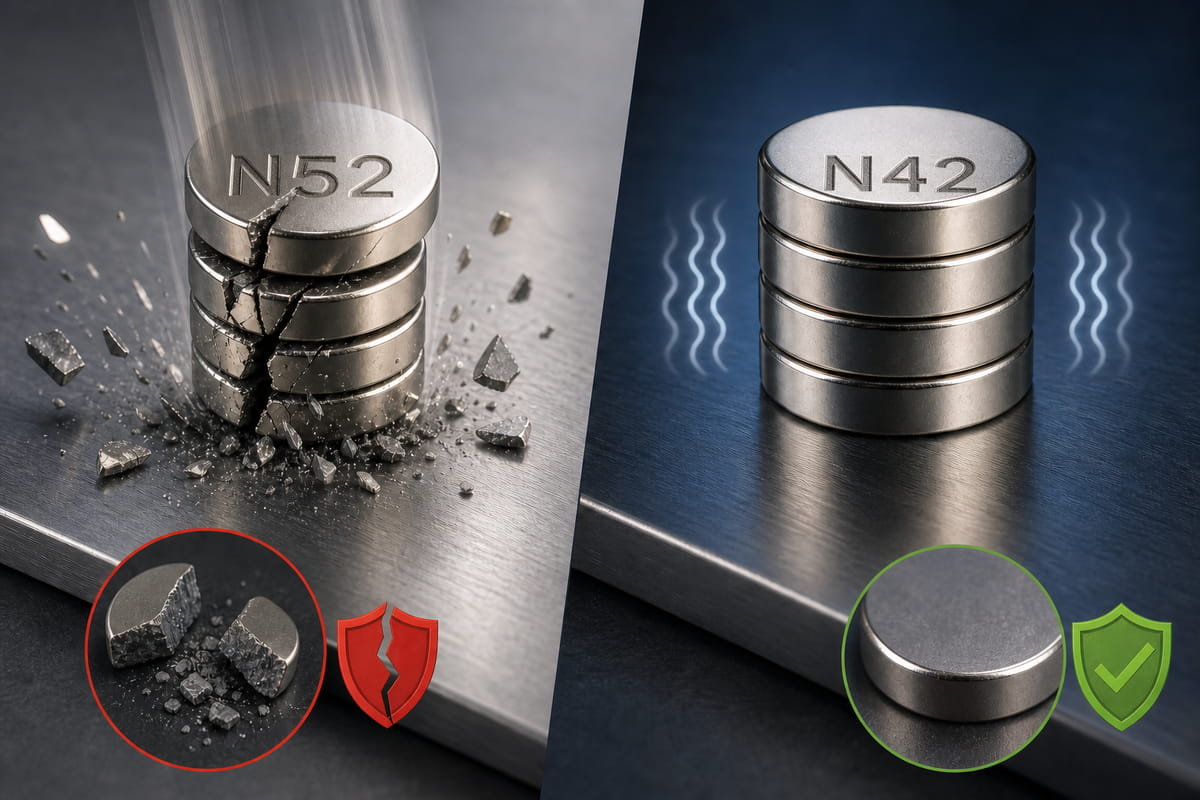
All neodymium magnets are brittle. They chip, crack, and shatter like ceramic.
But N52 is slightly worse.
Because it forces more magnetic flux into the same volume, the internal tension is higher. And when N52 snaps to a metal surface? It hits harder. That impact velocity makes it more prone to shattering.
My take: If your magnets will experience repeated impacts or vibration, N42 magnet is the safer bet.
4. Cost and Availability
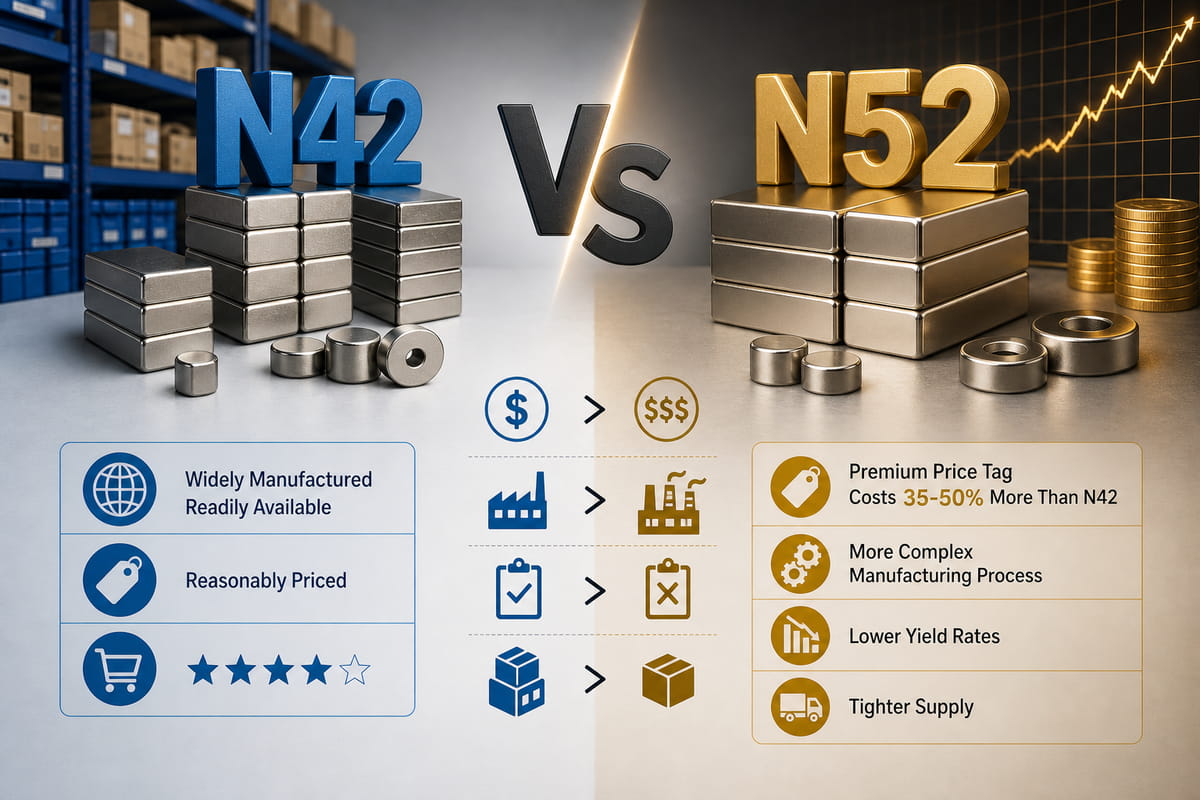
Here’s the deal:
N42 is the workhorse grade. It’s widely manufactured, readily available, and reasonably priced.
N52? Premium price tag.
In fact, N52 can cost 35-50% more than N42. And sometimes double.
Why? The manufacturing process is more complex. Yield rates are lower. Supply is tighter.
Plus, there’s a dirty little secret in the magnet world: many cheap “N52” magnets you find online are actually mislabeled N42 or even N35.
I’ve seen it firsthand. You order N52, and it feels weak. That’s because it’s not actually N52.
N52 vs n42 Magnets: Side-by-Side Comparison
| Feature | N42 | N52 |
|---|---|---|
| Max Energy Product | ~42 MGOe | ~52 MGOe |
| Residual Induction | ~13,200 Gauss | ~14,800 Gauss |
| Pull Force (relative) | Baseline | ~20-24% stronger |
| Max Operating Temp | ~80°C | ~60-65°C |
| Cost | Lower | 35-50% higher |
| Availability | Excellent | Limited |
| Brittleness | Standard | Slightly higher |
When to Choose Each
When to Choose N42 Magnets
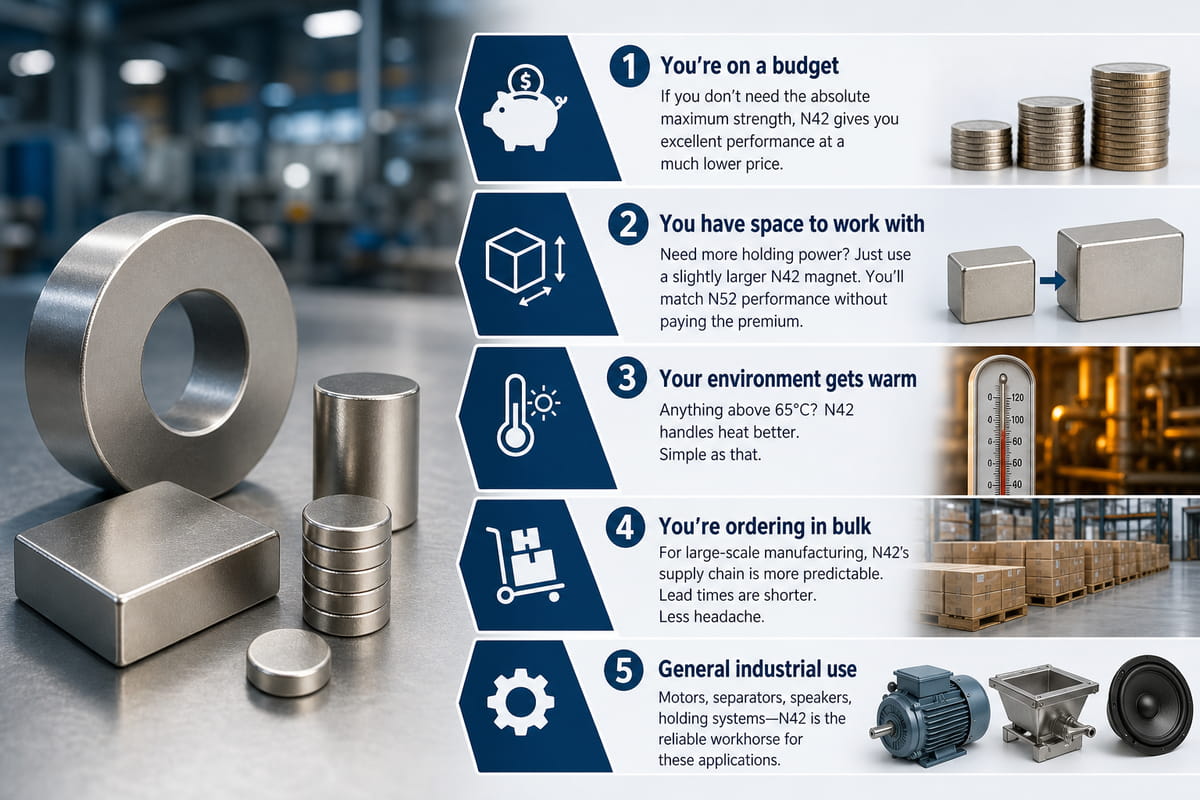
Here’s where N42 magnet shines:
1. You’re on a budget If you don’t need the absolute maximum strength, N42 gives you excellent performance at a much lower price.
2. You have space to work with Need more holding power? Just use a slightly larger N42 magnet. You’ll match N52 performance without paying the premium.
3. Your environment gets warm Anything above 65°C? N42 handles heat better. Simple as that.
4. You’re ordering in bulk For large-scale manufacturing, N42’s supply chain is more predictable. Lead times are shorter. Less headache.
5. General industrial use Motors, separators, speakers, holding systems—N42 is the reliable workhorse for these applications.
When to Choose N52 Magnets
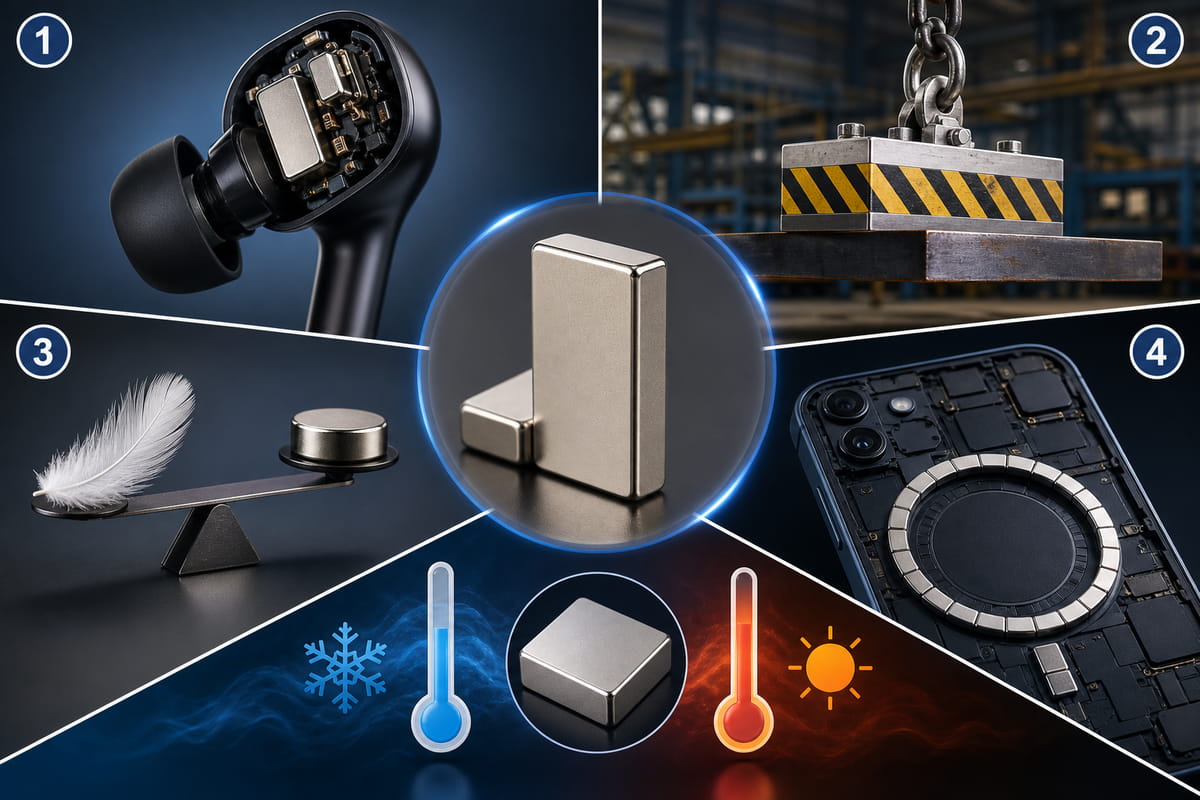
N52 is your go-to when:
1. Space is extremely tight Think earbuds, compact robotics, or precision medical devices. When every millimeter matters, N52’s higher energy density is a lifesaver.
2. You need maximum holding power If you’re building a magnetic lifter or a high-strength assembly, N52 delivers.
3. Weight is a constraint N52 lets you use smaller, lighter magnets for the same performance.
4. You’re designing high-end consumer electronics Apple uses N52-grade magnets in some of their products. That’s the caliber we’re talking about.
5. Room temperature only If your magnet stays cool (under 60°C), N52’s temperature weakness isn’t a factor.
A Quick Word on Quality
I mentioned this earlier, but it’s worth repeating:
Not all “N52” magnets are actually N52.
I’ve bought cheap N52 discs from online marketplaces that pulled less than half the expected force.
How to protect yourself:
- Check for published pull force data. If a seller won’t share it, walk away.
- Look for verified specs. Trustworthy suppliers test their magnets.
- Use the kitchen scale test. Stick your magnet to a steel plate on a scale, pull straight down, and note the peak reading. Compare to the spec.
(More on that testing method in a minute.)
N52 vs n42 Magnets: Which Should You Pick?
Here’s my simple framework:
Choose N42 magnets if:
- You’re cost-conscious
- You have room to use a slightly larger magnet
- Temperatures might exceed 65°C
- You need durability against impacts
- You’re ordering large quantities
Choose N52 magnets if:
- Space is at a premium
- You need every ounce of pull force possible
- Operating temps stay cool
- Weight matters
- You’re building high-performance or precision equipment
How to Test Your Magnets
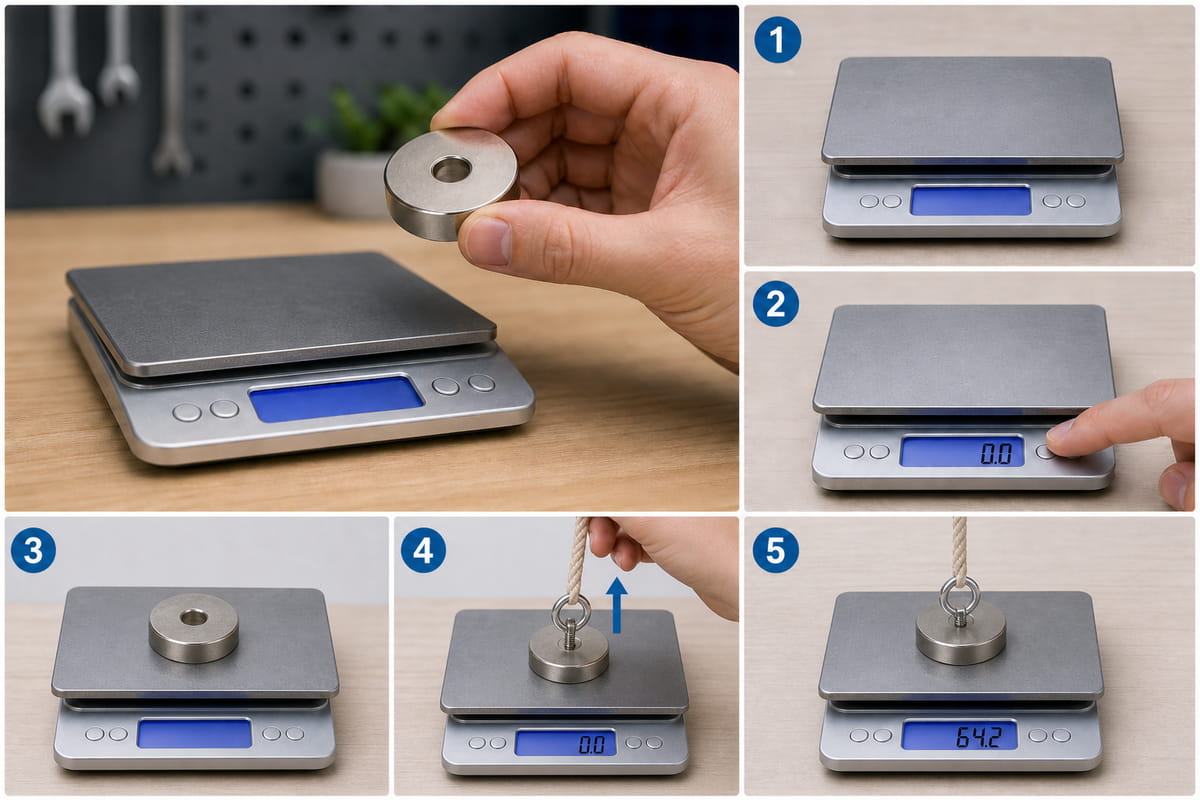
Got some magnets you’re not sure about?
Here’s a dead-simple test:
- 1. Place a flat steel plate on a digital kitchen scale
- 2. Zero the scale out
- 3. Stick your magnet to the underside of the plate
- 4. Slowly pull straight down until it releases
- 5. The peak reading is your pull force
Compare that number to the manufacturer’s spec. If it’s way off—say, half the expected force—you got scammed.
The Bottom Line
Look, I get it.
You want the strongest magnet you can get.
But N52 vs n42 magnets isn’t about “which is better.” It’s about what’s right for YOUR application.
- N52 is stronger. It’s also more expensive, more sensitive to heat, and slightly more brittle.
- N42 is the reliable, cost-effective choice that handles real-world conditions better.
Pro Tip: When in doubt, go with N42 magnets. You can almost always make up the strength difference by using a slightly larger magnet. And you’ll save money in the process.
But if you’re designing something where every millimeter counts—and you can control the temperature—N52 is your best friend.
Either way, buy from a reputable supplier. Test your magnets. And don’t trust every “N52” label you see online.
Now go build something awesome.


